
Table of Contents
- Why Mold Grows Under Pontoon Boat Covers
- Step 1: Prepare Your Boat Before Covering
- Step 2: How to Prevent Water Pooling on Pontoon Cover
- Step 3: Best Boat Cover Ventilation Tips
- Step 4: Use Moisture Absorbers and Desiccants
- Step 5: Choose Marine-Grade Vinyl Protection
- Step 6: Cleaning Mold Off Marine Vinyl
- Step 7: Establish a Regular Maintenance Routine
- Frequently Asked Questions
Last Updated: September 23, 2026
Why Mold Grows Under Pontoon Boat Covers
Mold and mildew thrive in dark, damp spaces. Your pontoon boat cover creates the perfect environment for them. When moisture gets trapped underneath, spores colonize the canvas and interior surfaces within days.
Step 1: Prepare Your Boat Before Covering
Start before the cover goes on. A clean, dry boat is your first defense against mold.
Remove gear and soft goods
Remove all soft goods, cushions, towels, life jackets, coolers, and store them indoors. Soft goods trap humidity and become breeding grounds for mold spores. Leaving the boat empty cuts mold risk dramatically.
Clean and dry the interior thoroughly
Wipe down all surfaces with a clean, dry cloth to remove dust, algae, and debris, paying special attention to corners and crevices. Open the boat to sunlight for several hours if weather permits and use towels to absorb moisture. The drier your boat is when you cover it, the less condensation will form later.
Step 2: How to Prevent Water Pooling on Pontoon Cover
Water pooling is the #1 cause of mold under pontoon boat covers. Stagnant water sits on the canvas for weeks, seeping through seams and vents. The fix is elevation: your cover needs to slope downward so water runs off instead of collecting.

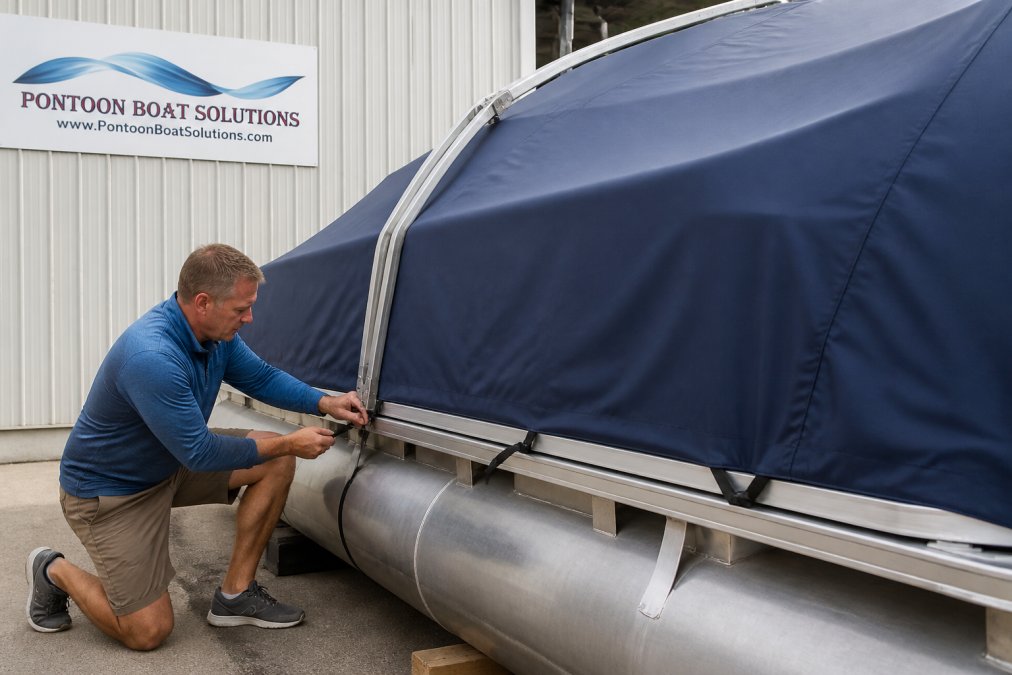
Aluminum support dome structure elevating a pontoon cover to prevent mold under pontoon boat cover via drainage
Install support poles or dome structures
Support poles or dome structures hold the cover up and create a peaked roof so water runs downhill to the edges. Traditional support poles require drilling into your boat, which can damage it. A better option is a pontoon rail/floor-supported system that doesn’t require holes or fasteners.
Check cover slope and adjust positioning
Even with supports, a poorly positioned cover will sag. The cover should peak in the middle and slope down on all sides. If water is collecting anywhere, adjust the supports until the slope is even.
Step 3: Best Boat Cover Ventilation Tips
Trapped air is as dangerous as trapped water. Condensation forms on the underside of the cover when warm, humid air meets the cool canvas. Your cover needs breathable fabric and air vents to allow moisture to escape. Ventilation strategy depends on where you store your boat.
Assess your climate and humidity profile
High-humidity coastal regions require aggressive ventilation; arid inland climates can rely on lighter ventilation with desiccants. Determine your storage location’s typical humidity range using National Weather Service data. If storing near salt water, plan for enhanced airflow. This assessment shapes cover fabric choice, moisture absorber quantity, and inspection frequency.
Create air flow with breathable fabric
Look for covers made with breathable fabric or mesh panels that allow air to circulate while blocking liquid water. For high-humidity climates, three-layer breathable construction is worth the premium cost. Check the cover’s breathability rating (measured in grams of water vapor transmission per square meter per 24 hours).
Install air vents and circulation openings
Install vents on opposite sides of the boat for cross-ventilation. Alternatively, prop open a small section of the cover on the downwind side to create natural air circulation. For dedicated vents, use mushroom-style designs that shed water while allowing vapor to escape. Install solar-powered fans under the cover to aid in circulation, if possible.
Manage seasonal ventilation changes
Ventilation needs shift with the seasons. In spring and fall, when condensation risk peaks, increase ventilation by opening vents wider. In summer, ventilation prevents heat buildup that can warp the cover and accelerate mold growth. If you’re in a region with seasonal humidity swings, adjust your vent configuration twice per year.
Step 4: Use Moisture Absorbers and Desiccants
Even with good ventilation, some moisture will remain. Moisture absorbers pull humidity from the air and reduce the conditions mold needs to grow, but dosing depends on your boat’s size and climate.
Choose the right desiccant for your cover fabric
Calcium chloride is cheap and effective but can become a liquid brine if saturated, potentially staining covers. For solid marine-grade vinyl, use calcium chloride on a tray to catch leakage. For breathable fabric covers, silica gel packets are safer. Alternative options include sealed desiccant cartridges or charcoal-based absorbers.
Calculate absorber quantity by boat size and climate
The amount of desiccant needed depends on your boat’s size and region’s humidity. As a baseline: boats under 20 feet need 2-3 containers; boats 20-30 feet need 4-6 containers; boats over 30 feet need 8+ containers. If storing in high-humidity coastal zones, increase quantities by 50%.
Position absorbers strategically
Place absorbers in the lowest point of the boat, inside enclosed cabins, and near the bow and stern where air circulation is weakest. Always use a waterproof tray or plastic mat underneath to prevent staining if the desiccant liquefies or leaks.
Monitor and replace on schedule
Check absorbers monthly and replace when saturated. Most containers change color when full. In high-humidity climates, replace every 2-4 weeks; in moderate climates, monthly; in arid climates, every 6-8 weeks. Keep a log of replacement dates to prevent forgetting mid-season.
Combine absorbers with ventilation for best results
Desiccants work best alongside ventilation, not as a replacement. The ideal strategy is moderate ventilation plus targeted desiccants to handle residual humidity. In high-humidity climates, desiccants become essential; in arid climates, they’re optional.
Step 5: Choose Marine-Grade Vinyl Protection
Look for covers made with marine-grade vinyl, which is UV-resistant, waterproof, and resists mildew better than untreated fabric.
Step 6: Cleaning Mold Off Marine Vinyl
Even with prevention, mold sometimes appears. Catch it early and it’s easy to remove. Ignore it and it spreads.
Spot-treat mildew and mold stains
For small spots, use a mildew-resistant cleaning solution. Mix one part white vinegar with three parts water. Spray the affected area and let it sit for 15 minutes. Scrub gently with a soft brush. Rinse thoroughly with clean water.
Deep cleaning and fabric treatment
For larger mold growth, you need a deeper clean. Use a marine-specific mold cleaner. Follow the product instructions carefully. Most require mixing with water and letting the solution sit for a period of time before scrubbing.
Step 7: Establish a Regular Maintenance Routine
Prevention is easier than cure. A simple monthly check during storage prevents 90% of mold problems.
Monthly inspections during storage
Every month, check your boat. Look for water pooling on the cover. Check for signs of mold on the canvas or interior. Verify that support poles are still holding the cover up. Replace moisture absorbers if they’re saturated.
Post-storage inspection checklist
Before you use the boat again, do a thorough inspection:
- Check the cover for mold or mildew stains
- Inspect the interior for mold on seats, carpet, or trim
- Look for water damage or soft spots
- Verify that all moisture absorbers have been removed
- Check the cover for tears or damage
- Inspect seams and vents for mold growth
- Wipe down all surfaces with a clean, dry cloth
- Run the ventilation system to dry the interior
- Check for musty odors that indicate trapped moisture
|
Maintenance Task |
Frequency |
Time Required |
Impact |
|---|---|---|---|
|
Check for water pooling |
Monthly |
5 minutes |
Prevents standing water |
|
Replace moisture absorbers |
Monthly |
10 minutes |
Removes trapped humidity |
|
Inspect for mold spots |
Monthly |
10 minutes |
Catches early growth |
|
Full cover cleaning |
Annually |
1-2 hours |
Removes all mold spores |
|
Post-storage inspection |
Once per season |
30 minutes |
Ensures boat is dry before use |
Frequently Asked Questions
How do I stop mold from growing under my boat cover?
Mold thrives in trapped moisture and stagnant air. Stop it by combining three strategies: first, ensure proper ventilation by installing breathable covers or air vents to allow air circulation; second, eliminate water pooling by using support poles or dome structures that slope water away; third, place moisture absorbers like calcium chloride inside the boat to absorb condensation. Check monthly during storage and remove any visible mildew immediately with a cleaning solution designed for marine vinyl.
Does ventilation prevent mold under boat covers?
Yes. Ventilation is critical because mold spores need stagnant, humid air to grow. Good air flow reduces condensation buildup and keeps moisture from accumulating under the cover. Use breathable fabric covers, install air vents at the cover’s lowest and highest points, and ensure support structures don’t block air movement. Proper ventilation combined with moisture absorbers and regular inspections dramatically reduces mold risk compared to sealed covers with no air circulation.
What is the best way to keep moisture out of a pontoon boat during storage?
Start with preventative maintenance before covering: remove all soft goods like cushions and upholstery, clean and completely dry the boat interior, and wipe down surfaces with a cloth. Then use a combination of moisture control methods: place desiccant products inside, ensure your cover has adequate ventilation, eliminate water pooling with proper support systems, and avoid covering the boat immediately after rain or cleaning. Check the boat monthly and allow sunlight and drying time when weather permits.
Should I use a dehumidifier in my boat during storage?
A dehumidifier can help in humid climates or if your boat is stored in an enclosed space like a garage or shed. However, for boats stored outdoors under a cover, focus on ventilation and desiccant products first—they’re more practical and cost-effective. If you do use a dehumidifier, ensure your cover has adequate air vents so the unit can function properly. Combine it with moisture absorbers and regular inspections for maximum protection against mildew and condensation.