
Table of Contents
- Quick Comparison: No Drill Pontoon Cover Support Options
- Why Avoid Drilling Pontoon Boat Rails
- Types of No Drill Support Systems: Poles, Arches, and Straps
- Preventing Water Pooling on Pontoon Covers
- DIY Pontoon Cover Support System: Step-by-Step Installation
- Material Durability and Long-Term Performance
- Maintenance, Storage, and Compatibility Tips
- Conclusion
- Frequently Asked Questions
Last Updated: September 21, 2026
Quick Comparison: No Drill Pontoon Cover Support Options
A no-drill pontoon cover support system holds a mooring or storage cover above the deck using floor contact, tension, or rail channel instead of screws. This guide from Pontoon Boat Solutions breaks down poles, arches, straps, and hybrid setups.
Here’s the short version before the details:
|
System Type |
How It Holds |
Best For |
Main Weakness |
|---|---|---|---|
|
Telescoping poles |
Cam lock, floor to cover peak |
Budget setups, small boats |
Tips in wind, needs straps |
|
Floor-supported arches |
Solid frame, spans the beam |
Wide beams, heavy snow load |
Higher upfront cost |
|
ULTIMATE Canvas Solution |
Forms a 5-way Aluminum/PVC cage with center support, from front to back, side to side, and a center leg to floor support. |
Winter and Year-round storage |
Initial purchase price. |
|
Canvas Solution + strap |
Forms a 5-Way PVC cage with center support, from front to back, side to side, and a center leg to floor support. |
Seasonal outdoor storage |
PVC only |
Why Avoid Drilling Pontoon Boat Rails
Third: rails hold fencing and gates, not the downward force of a snow-loaded cover. Floor-supported designs move that load to the deck, where it belongs.
Types of No Drill Support Systems: Poles, Arches, and Straps
Three designs dominate the category, each trading off cost, stability, and setup time. Here’s how each carries load, where it fails, and which boats it suits.
Telescoping Poles and Cam Lock Mechanisms
A telescoping pole extends to height and locks with a cam lock, a lever clamping the inner tube against the outer. That clamping force is finite: a cam lock slips once downward load exceeds its grip, which is why poles carry a working-height rating rather than a load rating.
Floor-Supported Arches and Dome Systems
Floor-supported arches rest on the deck and rise into a dome the cover drapes over. The key difference from a pole is the load path: a pole sends load straight down through one small base, while an arch spreads it across two or more feet and along the frame’s curve, so no single contact point sees the full weight of a snow-loaded or rain-soaked cover.
Gator Bites and Hybrid Setups
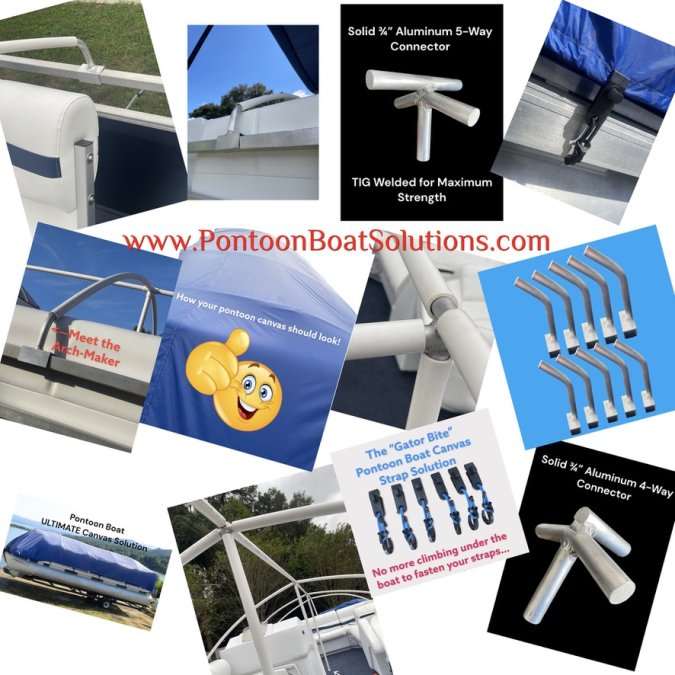
Gator Bites are designed with high-quality military shock cord that “bite” the cover without tearing, and run down to the rub rail pulling the canvas taut. Easy to adjust and can be left on the canvas for ease of canvas installation. Traditional straps stretch and lose tension over a season, and they don’t create height, they only pull fabric tight between existing points.
Matching the Design to Your Boat
A quick decision path:
- Narrow beam, mild climate, tight budget: telescoping poles plus straps or Pontoon Boat Canvas Solutions
- Wide beam, snow load, year-round outdoor storage: floor-supported arch or dome i.e. Pontoon Boat ULTIMATE Canvas Solutions.
- Temporary cover between trips: straps alone, accepting that they will need re-tensioning.
- High-wind or trailering use: arch or dome as the primary frame, straps as secondary hold-downs.
The pattern across all three designs is the same: more contact points and wider load distribution mean less load on any single point, and a cover that keeps its peak longer.
Preventing Water Pooling on Pontoon Covers
Water pooling happens when the cover loses its peak, and the fix is a consistent high point across the full length of the boat. Canvas sags between support points, so a single middle pole creates two low spots on either side. Every support point you add reduces the span, and shorter spans sag less.
DIY Pontoon Cover Support System: Step-by-Step Installation
A floor-supported system installs in an afternoon with no power tools, alone. The steps below assume an arch-style setup, the most stable option for outdoor storage.

Boat owner positioning a no drill pontoon support arch under a canvas cover on a sunny driveway
Total time: 45 to 90 minutes Difficulty: Beginner
What You’ll Need Before You Start
- Your arch or pole system, fully unpacked and counted
- A tape measure
- Clean deck space with the cover removed
- A second person for wide beams, optional but helpful
Common Mistakes to Avoid During Setup
Mistake 1: Setting the peak too low. If the arch leaves the cover nearly flat, you’ve built a shallow roof that pools. Raise the frame until the canvas slopes clearly toward the edges.
Material Durability and Long-Term Performance
For a broader look at how UV exposure and moisture affect marine materials, the National Oceanic and Atmospheric Administration marine debris and materials guidance covers environmental exposure factors that apply to any outdoor marine equipment.
Maintenance, Storage, and Compatibility Tips
A support system lasts longer when you treat it like the rest of your boat gear. Here’s the maintenance routine, then the two compatibility factors that matter most.
Routine Maintenance and Storage
Rinse aluminum components with fresh water after saltwater exposure, dry before storage, and inspect contact points each season for scratches or wear. On anodized aluminum, a deep scratch exposes bare metal and becomes a corrosion start point, so touch up any gouge before it spreads. Store arch sections flat, not leaning, and keep cam locks clean, grit reduces their grip and lets a pole slip under load.
Wind Load and Storm-Proofing
Most guides focus on water pooling and stop there. Wind is the other half: a cover acts like a sail, and the larger the flat or low-slope area, the more lift it generates, pulling the cover edge up and away from the frame. That’s why a system that holds a perfect peak in calm weather can still fail in a gust.
Three things reduce wind risk:
- Dome shape over flat shape. A curved cover sheds wind pressure instead of catching it. If your cover sits nearly flat, raising the peak is a wind fix as much as a pooling fix.
- Straps as secondary hold-downs. The frame holds the shape; straps hold the cover to the frame. Run straps from the cover edge to the trailer or deck so a gust cannot lift the edge and peel the cover back. Gator Bites have military shock cord to keep the canvas taut even in winding conditions.
- Weighted or non-slip bases. On a slick deck, add a non-slip pad under each contact point, the detail most people skip, and the one that keeps an arch from walking in a storm.
Cover Fabric and Tension Compatibility
Different cover fabrics require different support tension:
- Heavier fabrics such as acrylic and solution-dyed polyester hold a dome shape well and tolerate moderate tension. They resist stretching, so a frame that holds a firm peak will keep the cover taut across seasons.
- Lighter fabrics and covers with elastic corners stretch more and pull off a frame in wind unless you use straps. They also sag faster between support points, so they need more support points, not just a higher peak.
Vinyl covers sit in between: they shed water well but stiffen in cold weather and can crack at a sharp fold. Avoid sharp frame edges and keep the dome curve gentle.
Beam Width and Cover Type
Check three things before you buy:
- Beam width: the frame must span your boat’s actual beam, not the nominal length. A 25-foot pontoon with a wide beam needs a frame rated for that width.
- Cover type: snap-on covers tension differently than mooring covers, so confirm the system works with your cover style.
- Storage duration: a system used for a weekend between trips has different requirements than one left on all winter under snow load.
One more consideration: long-term contact between a cover and the boat’s upholstery. A cover sitting directly on seating traps heat and moisture against the vinyl, speeding up cracking and fading. Keeping the canvas elevated is one of the cheapest ways to protect interior vinyl, and it’s the same airflow that prevents mildew under the cover. The Pontoon Boat Canvas Solutions have various height “Arch-Makers” to keep the cover off the furniture.
Conclusion
The real challenge with pontoon cover support isn’t finding hardware, it’s finding hardware that holds a true peak across a wide beam without putting holes in your rails, like the Pontoon Boat Canvas Solutions. Poles work until the wind shifts them. Straps work until they stretch. A floor-supported arch system solves both problems at once, and that’s exactly what Pontoon Boat Solutions builds. Our patent-pending Arch-Makers create a custom dome using heavy-duty solid aluminum, with no screws, nuts, bolts, glue, or holes to drill, and the whole system installs in an afternoon.
Frequently Asked Questions
Why should you avoid drilling into pontoon boat rails?
Drilling into aluminum rails creates entry points for water, which leads to corrosion and weakens the structural integrity of the rail over time. It also voids many manufacturers’ warranties and lowers resale value. Once holes are drilled, they cannot be undone without costly repairs or replacement. No drill pontoon cover support systems eliminate this risk entirely by using floor-supported arches or tension-based designs that keep the cover elevated.
How do no drill pontoon cover support systems work?
Most no drill systems rely on floor-supported arches, telescoping poles, or tension straps that create a dome shape under the canvas cover. The support slide on the rail and pushes the cover upward, allowing water to run off instead of pooling. Cam lock mechanisms and adjustable height settings let you customize the pitch for your specific pontoon size. Because nothing is fastened to the rails, there is no drilling, no hardware, and no damage to the boat.
Can you support a pontoon cover without damaging the aluminum railing?
Yes. Floor-supported dome systems and tension-based supports rest on the rails withour fasteners. Avoid any setup that requires tightening straps directly against bare aluminum, as vibration during trailering can wear through the finish.
How do you prevent water pooling on a pontoon boat cover without drilling?
The key is creating a peak or dome under the cover so water sheds naturally. Use a floor-supported arch system or adjustable telescoping poles positioned at the center and along the length of the boat. Aim for a pitch of at least 6 inches of rise per 10 feet of boat length. Ensure airflow circulation by leaving small gaps at the ends. This prevents sagging, mildew prevention, and keeps your mooring cover or storage cover tight through rain and snow.
This article was written for informational purposes and reflects general guidance on pontoon cover support systems. Always check your boat’s specific dimensions and your cover manufacturer’s recommendations before installing any support hardware.