
Table of Contents
- Why Pontoon Covers Sag and What It Costs You
- Pontoon Boat Cover Support Poles: Types and How to Choose
- Preventing Water Pooling on Boat Covers: Tension and Drainage Basics
- DIY Boat Cover Support Ideas That Actually Hold Up
- Screw-Free Support Systems: What to Look For Before You Buy
- Wind-Load Considerations: Keeping Your Cover Secure in a Storm
- Long-Term Storage vs. Short-Term: Matching the Fix to the Season
- Quick Visual Troubleshooting: What Your Sagging Cover Is Telling You
- Frequently Asked Questions
Last Updated: September 15, 2026
Why Pontoon Covers Sag and What It Costs You
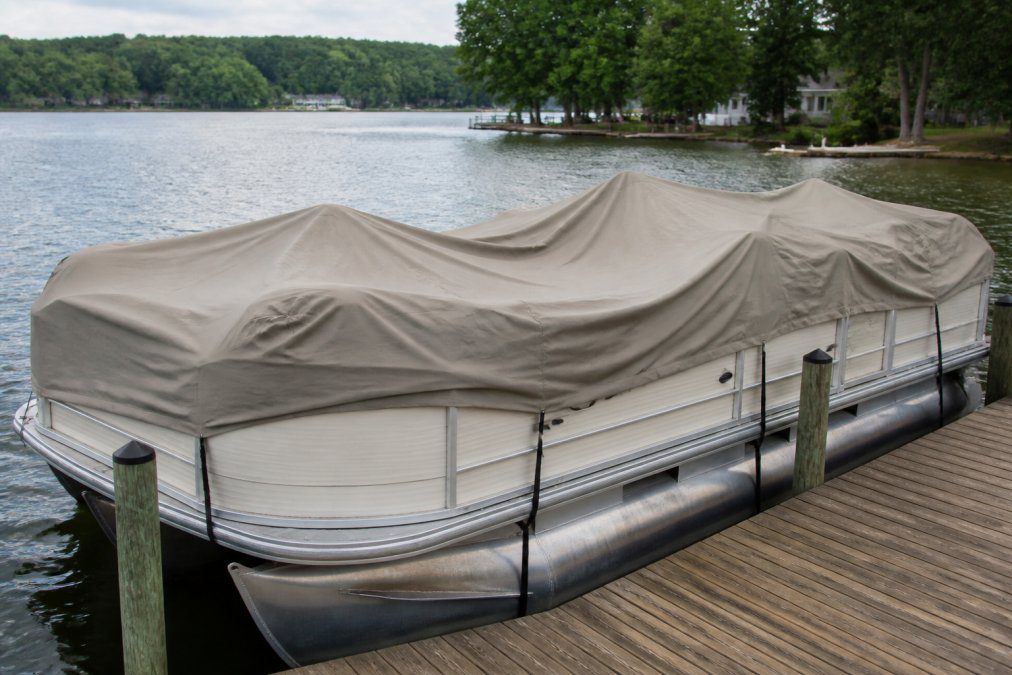
Pontoon cover sagging happens when nothing holds the canvas up from underneath, so rain and snow collect in low spots instead of running off. The cover isn’t usually the problem, the missing support structure is.
This guide from Pontoon Boat Solutions breaks down fixes, from cheap DIY props to permanent hardware, and explains which fits your boat and season.
The Real Damage: Water Pooling, Mildew, and Furniture Rot
A sagging cover becomes a shallow basin: water pools in the center, the canvas stretches, and the sag deepens with every storm. That standing water seeps through seams and pinholes, then sits on your upholstery for days.
The consequences compound quietly:
- Mildew prevention fails first. Damp canvas and trapped humidity breed mildew on the underside of the cover and on seat vinyl.
- Furniture rot follows. Pontoon seating uses plywood and foam cores. Once water reaches them, rot spreads and replacement costs run into the thousands.
- Cover integrity drops. Repeated stretching weakens fabric and stitching until the cover tears at the lowest point.
Pontoon Boat Cover Support Poles: Types and How to Choose
Pontoon Boat Solution Canvas Solutions create domes with vertical support poles that support the canvas up from the deck, creating a dome so water runs off. Two designs dominate: telescoping and fixed-length.
Choose based on how often you cover the boat and how much adjustability you need. Too short leaves the sag; too tall puts a spike of pressure under the canvas that wind works loose.
Telescoping Poles vs. Fixed-Length Poles
Telescoping poles adjust to different heights, handy when you store gear under the cover or switch between towing and storage. The trade-off is more moving parts and failure points.
Fixed-length poles are simpler and sturdier, but fit only one height. On a pontoon, that’s often a problem, since the cover needs support across a wide beam, not one point.
|
Pole Type |
Best For |
Main Drawback |
Adjustability |
|---|---|---|---|
|
Telescoping |
Changing storage heights |
More failure points |
High |
|
Fixed-length |
Single storage position |
One height only |
None |
|
Multi-point arch systems |
Wide beams, all-season use |
Higher upfront investment |
Set once, stays put |
Preventing Water Pooling on Boat Covers: Tension and Drainage Basics
Preventing water pooling on boat covers comes down to two things: a dome that sheds water and tension that keeps the canvas from sagging between supports. You need both: a dome without tension sags at the edges, and tension without a dome makes a flat roof that holds water like a table.
Start with trailer tilt: nose the trailer up slightly so the cover’s lowest point is at the rear, where water runs off instead of collecting in the middle. Then set your supports to create a dome cage from bow to stern.
Tension straps and/or Gator Bites pull the canvas taut at the hem. Check them after every storm; Gator Bites keep the canvas taut, but straps can let it relax, so a cover tight in October can be loose by January.
DIY Boat Cover Support Ideas That Actually Hold Up
DIY boat cover support ideas range from a trash can to a purpose-built frame. Some work for a season, a few for years. The difference is how well the support spreads load across the beam instead of concentrating it at one point, and whether the prop matches your cover fabric’s tension characteristics.
Trash Cans, Sawhorses, and Other Quick Fixes
A clean plastic trash can placed amidships props up the cover’s center, free if you own one, and fine for short-term storage.
Match the Prop to Your Cover Fabric
Most guides treat every cover the same.
Why Most DIY Supports Fail by Mid-Season
Most DIY supports fail for three predictable reasons:
- They shift. Wind, trailer movement, and canvas tension push a free-standing prop out of position. Move an inch, and the support is gone.
- They concentrate load. A single contact point spikes pressure that stretches the canvas above it, permanently, on stretchy polyester.
- They corrode or degrade. Steel sawhorses rust, plastic bins crack in cold, wood warps in humidity. A prop that fails in February under snow load is worse than none, leaving the canvas unsupported at the worst moment.
The Load-Distribution Test
Before trusting any DIY support, press down on the canvas a few inches from the prop.
Screw-Free Support Systems: What to Look For Before You Buy
When you evaluate a system, check these features:

Solid connected arches prevent pontoon cover sagging on a boat parked in a driveway on a sunny day.
- Multi-point support. Look for hardware that’s solidly built to create several high points across the beam, not one center pole.
- Floor-supported design. The system should stand on the deck, not rely on rail clamps or drilled mounts.
- Material durability. Solid aluminum resists corrosion in salt air and holds its shape under snow load.
- Tool-free installation. If it needs a drill, it isn’t screw-free.
Wind-Load Considerations: Keeping Your Cover Secure in a Storm
Wind is the failure mode most owners underestimate, and most guides skip.
How Wind Actually Causes Sagging
- Lift at the hem. Pressure under the cover pushes fabric up. If the hem isn’t secured below the rub rail, the cover inflates like a parachute. Gator Bites pull the canvas taut again.
- Flutter and abrasion. Even a tight cover flutters in a gust, rubbing against rail caps, cleats, and pole tops. Over a season, that abrasion thins the fabric until it tears at the low point.
- Support displacement. A free-standing prop has no anchor. A sustained gust slides it across the deck, the peak collapses, and the sag returns.
Securing the Cover Against Wind
Tie-downs are the first line of defense.
Wind and Support Systems
A Quick Wind-Readiness Check
- Hem secured below the rub rail at every tie-down point
- Straps crossed over wide spans, not just run straight down
- No free-standing props that can slide
- Bow angled into the prevailing wind if the lot is exposed
- Cover re-checked after every storm
Long-Term Storage vs. Short-Term: Matching the Fix to the Season
Short-term storage, a week or two between trips, tolerates a quick prop and a tight cover.
Quick Visual Troubleshooting: What Your Sagging Cover Is Telling You
|
What You See |
What It Means |
The Fix |
|---|---|---|
|
Center pool after rain |
No peak support |
Add a multi-point arch/cage system |
|
Sag between poles |
Support spacing too wide |
Add support struts or another arch |
|
Loose hem in wind |
Tension lost as canvas relaxed |
Re-tighten straps and bungee cords |
|
Mildew on underside |
Moisture buildup, poor ventilation |
Improve airflow, add solar fan, and drainage |
|
Tear at low point |
Long-term pooling stretched fabric |
Replace cover, fix support first |
Frequently Asked Questions
What is the best pontoon boat cover support system?
The best system depends on your boat’s beam and storage setup. Look for floor-supported arches or poles that create a dome under the canvas, allowing rain to run off instead of pooling. Screw-free designs that don’t require drilling into rails are ideal for preserving resale value. Adjustable tension straps and marine-grade materials also help the cover stay tight through wind and snow. Avoid any system that relies on a single center pole, which tends to shift and leave low spots.
How can I stop my boat cover from sagging without drilling holes?
Use a floor-supported support structure that stands on the deck and pushes up against the underside of the cover. Arch-Makers, for example, are solid aluminum arches that create a dome without screws, nuts, bolts, or glue. Place them along the centerline and at the bow and stern, then tighten the cover’s ratchet system or bungee cords. This keeps the canvas elevated and prevents water pooling on boat covers without any permanent modification to your pontoon.
How do I prevent water from pooling on my boat cover during winter storage?
First, pitch the cover so the highest point is in the center and water can run off the sides. Use a bow system or support poles to maintain that pitch. Tighten all tie-down points so the cover doesn’t sag between supports. Check the cover weekly and after storms to clear snow or standing water. If you store outdoors, consider a cover with a vent to reduce moisture buildup. A properly tensioned cover with good drainage stops pooling before it starts.
What are the long-term effects of water pooling on pontoon furniture?
Standing water on a cover seeps through seams and zippers, leading to mildew, mold, and rot in the pontoon’s upholstery and decking. Moisture buildup also corrodes electrical connections and can weaken the cover fabric itself. Over time, this shortens the life of expensive furniture and lowers resale value. Preventing water pooling on boat covers is far cheaper than replacing waterlogged cushions or repairing structural damage.