
Table of Contents
- Why Drilling Pontoon Boat Rails Causes Permanent Damage
- Galvanic Corrosion and Long-Term Structural Failure
- Warranty Voidance and Resale Value Impact
- No Drill Pontoon Accessories: Proven Alternatives
- Pontoon Boat Rail Corrosion Prevention Best Practices
- Repairing Stripped Screw Holes in Pontoon Rails
- Drilling vs. Non-Invasive Installation: A Practical Comparison
- Frequently Asked Questions
Last Updated: September 20, 2026
Why Drilling Pontoon Boat Rails Causes Permanent Damage
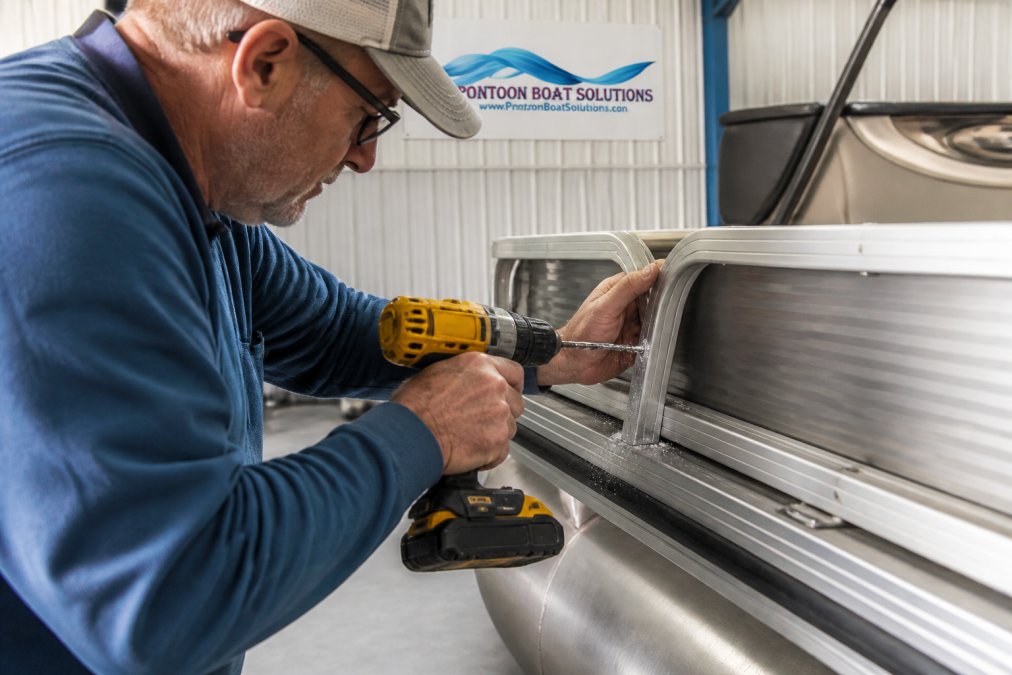
Drilling into pontoon boat rails creates irreversible structural damage that compromises the integrity of your investment. When you penetrate the aluminum extrusion, you bypass the factory-applied protective layers and expose the material to water intrusion. This isn’t a minor cosmetic issue, it’s the beginning of a cascade of failures that affects everything from the boat’s resale value to the safety of your furniture and equipment.
Once a drill bit penetrates the powder coating and anodized surface, water enters the hollow aluminum extrusion and becomes trapped. Seasonal temperature fluctuations cause this water to expand and contract, creating cumulative stress.
How water intrusion compromises aluminum integrity
Moisture entering through a drilled hole travels along the internal cavity and becomes trapped, creating conditions for corrosion.
The factory finish seals aluminum and prevents oxidation. Once broken by drilling, exposed aluminum oxidizes immediately, accelerating in marine environments. The white powdery residue is aluminum oxide, indicating the structural material is weakening.
Trapped water promotes mold and mildew growth, causing canvas covers, cushions, and upholstery to deteriorate faster from moisture-laden air escaping compromised rails.
Galvanic corrosion mechanics in marine environments
Galvanic corrosion occurs when two different metals contact in an electrolyte like saltwater. Drilling aluminum rails and installing stainless steel fasteners creates a galvanic couple where aluminum acts as the sacrificial metal, corroding to protect the steel.
This reaction accelerates in saltwater and occurs even in freshwater with minerals or road salt exposure. Electrons flow from the aluminum anode to the steel cathode, causing the aluminum to gradually dissolve.
Corrosion creates localized pitting that weakens the rail at the stress point of drilling, hidden inside the hollow rail where it develops unseen.
Galvanic Corrosion and Long-Term Structural Failure
Stainless steel fasteners, though considered safe for marine use, accelerate corrosion in aluminum pontoon rails through galvanic action, even in freshwater and severely in saltwater.

Why stainless steel fasteners accelerate oxidation
Stainless steel sits much higher on the galvanic scale than aluminum. In electrical contact, aluminum becomes the sacrificial metal as electrons flow to the steel, causing oxidation.
Corrosion accelerates with moisture and salt. Even freshwater storage shows measurable corrosion around stainless steel fasteners in a single season, increasing with salinity and temperature.
Pitting around the fastener hole creates stress concentrators that reduce load-bearing capacity by 20-30 percent or more, even when the rail appears sound.
Vibration fatigue and stress cracks from drilling
Rails experience constant vibration from waves, motor operation, and wind. They’re designed to handle these vibrations only if the structure remains intact.
Drilling creates a stress concentration point where vibration amplifies, leading to fatigue cracks that propagate over weeks or months of normal use.
Fatigue cracks start at the inside edge of drilled holes where stress is highest and invisible. They grow silently until reaching critical length, causing sudden failure under load. This is why drilling pontoon boat rails is particularly dangerous, failure is unpredictable and can occur during use.
Warranty Voidance and Resale Value Impact
Drilling voids the manufacturer’s warranty on rail components. Most manufacturers explicitly prohibit owner-initiated modifications to structural components, voiding coverage for related damage.
Warranty voidance leaves you responsible for full replacement costs if drilling causes failure. Rail replacement can cost thousands of dollars depending on boat size.
Resale value can drop when buyers discover drilled holes, signaling water intrusion and structural compromise.
No Drill Pontoon Accessories: Proven Alternatives
The market for non-invasive pontoon accessories has expanded significantly because boat owners recognize the risks of drilling. These alternatives deliver the functionality you need without compromising the structural integrity of your rails.
Clamp-on mounts and non-invasive installation
Clamp-on mounts work by gripping the rail extrusion without penetrating it. The clamping force distributes pressure across a wider surface area of the rail, which reduces stress concentration compared to a fastener that loads a single point. Quality clamp-on systems use rubber or plastic pads to protect the powder coating and prevent galvanic contact between the mount and the aluminum.
Installation takes minutes without tools after the first installation. You slide the clamp onto the rail, position it where you need it, and connect the supporting pieces to form the domes. The Pontoon Boat Canvas Solutions systems can be repositioned or removed without leaving any permanent marks. This reversibility is crucial for maintaining your boat’s resale value and keeping your warranty intact.
The load-bearing capacity of the Arch-Makers and center supports mounts depends on how you space your canvas solution. Well-engineered and spaced systems can support canvas cover support structures. Additional products like fishing rod holders, and light-to-medium accessories slide on the rail without issue.
Floor-supported systems and weight distribution
Floor-supported systems compliment the rail mounting system by placing support structures on the boat’s floor such as the Pontoon Boat Cooler Solution. These systems use vertical supports that rest on the deck or rub rails.
This approach offers several advantages. Weight is distributed across the entire floor area rather than concentrated at rail attachment points.
Pontoon Boat Rail Corrosion Prevention Best Practices
Even if you avoid drilling, your pontoon rails still need protection from the marine environment. Saltwater, UV exposure, and temperature fluctuations all contribute to corrosion and degradation of the powder coating.
Protecting powder coating and factory finish
The powder coating on your rails is a barrier between the aluminum and the corrosive environment. Once that barrier is compromised, whether through drilling, scratches, or UV degradation, corrosion accelerates. Protecting the powder coating is the most cost-effective way to prevent long-term damage.
Sealant application and seasonal maintenance
Applying a marine-grade sealant to exposed aluminum surfaces creates an additional protective layer. Sealants fill micro-cracks in the powder coating and prevent water from reaching the aluminum beneath. Reapply sealant annually or after heavy use in saltwater environments.
Repairing Stripped Screw Holes in Pontoon Rails
If your pontoon already has drilled holes from previous modifications, repair becomes necessary to prevent further deterioration. The goal is to seal the hole and prevent water intrusion while maintaining as much structural integrity as possible.
Epoxy repair methods for existing damage
Epoxy fills drilled holes and hardens into a solid mass that restores some structural integrity to the compromised section. Clean the hole thoroughly with a wire brush to remove any corrosion or debris. Dry the area completely, epoxy doesn’t cure properly in the presence of moisture.
When to replace versus repair compromised sections
Small holes (under 0.5 inches diameter) are good candidates for epoxy repair. Larger holes, multiple holes in the same rail section, or holes showing signs of advanced corrosion should prompt consideration of rail replacement. A rail section with severe pitting or structural cracks is no longer safe for load-bearing applications and should be professionally replaced.
Drilling vs. Non-Invasive Installation: A Practical Comparison
The choice between drilling and non-invasive alternatives comes down to functional requirements, long-term costs, and your commitment to preserving your boat’s value and structural integrity.
|
Factor |
Drilling |
Non-Invasive Alternatives |
|---|---|---|
|
Installation Time |
30-60 minutes |
15-30 minutes |
|
Structural Risk |
High |
None |
|
Water Intrusion Risk |
Immediate |
Zero |
|
Warranty Impact |
Voidance |
No impact |
|
Resale Value |
Reduces 10-15% |
No reduction |
|
Maintenance Requirements |
Ongoing corrosion management |
Minimal |
|
Load Capacity |
Variable by fastener |
Excellent with proper design |
|
Reversibility |
Permanent |
Fully reversible |
Installation time, ease of use, and customization options
Drilling requires precise measurements, the right drill bit size, and careful technique to avoid damaging internal components of the rail. Non-invasive slide-on systems skip these steps entirely. You position the Arch-Maker, slide it on, and you’re done. The simplicity translates directly to fewer installation mistakes and faster completion.
Load-bearing capacity and structural performance
Properly engineered products can handle substantial loads when the product is adequate and the contact surface is sufficient. The key difference from drilling is that the load is distributed across the rail’s outer surface rather than concentrated at a single fastener point. This distribution actually makes the dome systems more efficient at handling certain types of loads.
Frequently Asked Questions
Why is drilling into pontoon boat rails considered a bad idea?
Drilling creates entry points for water intrusion, which triggers galvanic corrosion when dissimilar metals (aluminum rails and stainless steel fasteners) interact in a marine environment. This corrosion weakens the structural integrity of your aluminum railing, leads to stress cracks, and can compromise the seaworthiness of your boat. Additionally, drilling voids most manufacturer warranties and permanently damages the factory finish, reducing resale value.
Can drilling into aluminum rails lead to galvanic corrosion?
Yes. Aluminum railings are highly susceptible to galvanic corrosion when exposed to saltwater or freshwater environments. When you drill and install stainless steel fasteners, you create a galvanic couple—two dissimilar metals in contact with an electrolyte (water). This triggers a chemical reaction that corrodes the aluminum much faster than natural oxidation. The corrosion spreads outward from the drilled hole, weakening the entire rail section over time.
How do no drill pontoon accessories compare to traditional drilling methods?
No drill pontoon accessories, such as channel mounts and floor-supported systems, eliminate water intrusion, galvanic corrosion, and structural damage entirely. They install without fasteners, preserve your factory finish, maintain your warranty, and protect your resale value. Installation is DIY friendly. Traditional drilling offers lower upfront cost but introduces permanent damage, ongoing maintenance costs, and warranty voidance—making non-invasive solutions more cost-effective long-term.
What should I do if my pontoon rails already have stripped screw holes?
Stripped screw holes can be repaired using epoxy-based fillers designed for marine aluminum. Clean the damaged area, apply marine-grade epoxy into the hole, and allow it to cure fully before re-drilling if necessary. For severe damage affecting multiple holes or structural sections, replacement of the damaged rail section is more reliable than repeated repairs. Prevent future issues by switching to no drill mounting solutions that eliminate the need for additional fasteners.