
Table of Contents
- Why Heavy Duty Pontoon Cover Support Matters
- How to Stop Pontoon Cover Sagging: The Core Problem
- Telescoping vs. Fixed Support Poles: What Works Best
- Pontoon Cover Support Pole Installation: Step-by-Step
- Heavy Duty Boat Cover Support Systems: Material & Durability
- Wind Load Dynamics and Support Capacity
- DIY vs. Commercial Solutions: Cost and Long-Term Value
- Conclusion
- Frequently Asked Questions
Last Updated: September 28, 2026
Why Heavy Duty Pontoon Cover Support Matters
A sagging pontoon cover isn’t just an eyesore, it’s a slow-motion disaster for your investment. Water pools in the low spots, mold creeps in, and before you know it, your canvas is rotting while your furniture underneath gets destroyed by moisture and UV exposure. The real cost of ignoring this problem compounds every season.
This is where heavy duty pontoon cover support becomes essential. A proper support system keeps your canvas elevated and taut, allowing rain and snowmelt to run off instead of collecting in pockets. The difference between a boat that looks maintained and one that’s deteriorating often comes down to whether the owner invested in the right support setup.
The single biggest factor in extending your pontoon cover’s lifespan isn’t the canvas quality, it’s keeping water from pooling on top. A heavy duty support system can significantly extend a cover’s lifespan.
How to Stop Pontoon Cover Sagging: The Core Problem
Pontoon cover sagging happens because canvas naturally sags under its own weight, especially when wet. Add rain, snow, or standing water, and the weight multiplies. Without structural support, the fabric stretches over time, creating permanent low spots where water collects. This standing water is the accelerant, it promotes mold growth, breaks down the canvas fibers, and damages whatever sits underneath.
The core problem isn’t the cover itself. Modern marine canvas is engineered to resist UV and saltwater. The problem is the lack of structural support to maintain the cover’s shape. Without proper elevation, gravity and moisture do what they always do: they win.
A proper heavy duty pontoon cover support system addresses this by creating a dome or ridge structure that sheds water naturally. Instead of water sitting in pockets, it runs off to the sides. The canvas stays taut, dries faster, and experiences less stress. The furniture underneath stays dry, the cover lasts longer, and you avoid the mold remediation nightmare.
Common mistakes include using undersized poles, spacing them too far apart, or failing to tension the cover properly. Each of these allows sagging to resume. The right system uses heavy-duty materials, proper spacing, and reliable tensioning mechanisms.
Ignoring cover sagging for even one full season can cause permanent damage. Canvas that stays wet for months will develop mold that’s nearly impossible to clean and structural damage that no amount of drying will reverse.
Telescoping vs. Fixed Support Poles: What Works Best
The choice between telescoping and fixed-length poles comes down to your specific boat geometry and how you plan to use the system. Both have legitimate use cases, neither is universally better.
Fixed-length poles are built to a specific height for a specific boat model. They’re rigid, don’t move, and provide maximum structural support because there’s no mechanism to fail. The downside: they’re inflexible. If your boat’s beam or cover dimensions are slightly different than the standard, a fixed pole might not fit properly. Installation requires knowing your exact measurements.
Telescoping poles offer flexibility in height adjustment, which matters when you’re dealing with multiple boats or uncertain measurements. You can dial in the exact height you need. The trade-off is mechanical complexity, a telescoping mechanism (twist lock, cam lock, or sliding collar) can loosen over time, especially in marine environments with salt spray and temperature swings.
For most pontoon owners, the real decision isn’t the pole type, it’s whether you want a system designed specifically for pontoon geometry. Pontoon boats have a unique footprint: wide, relatively flat decks with specific rail mounting points and cover attachment locations. A generic support pole system designed for fishing boats or center-console cruisers won’t account for these differences.
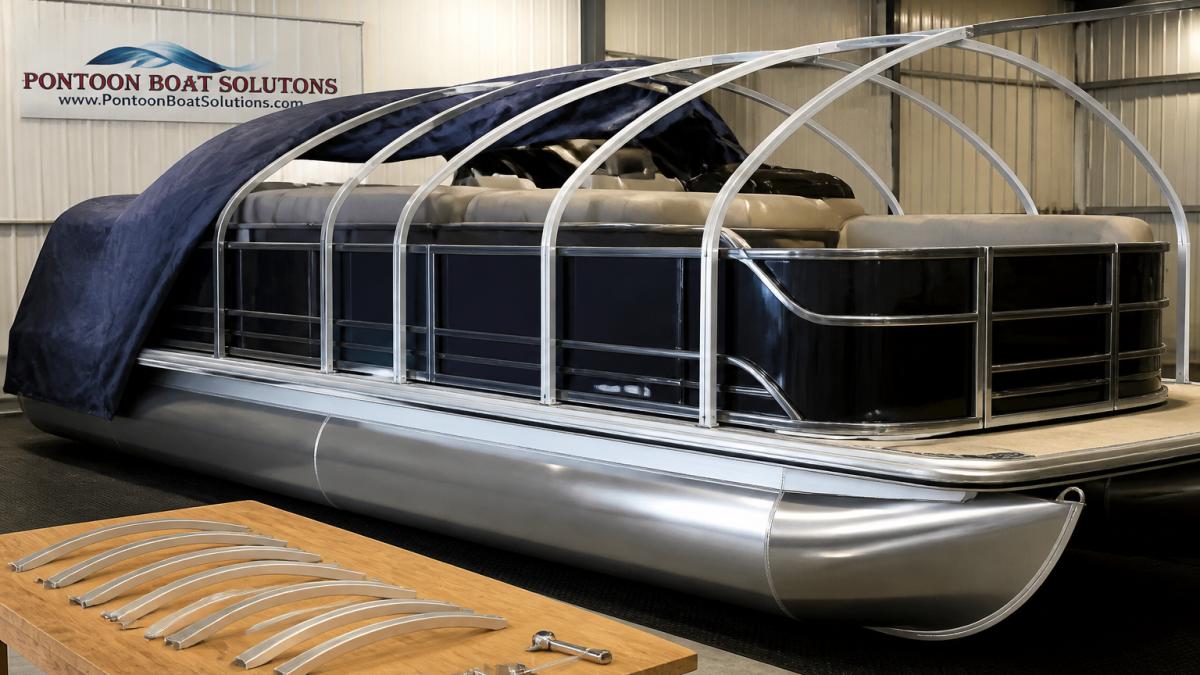
Pontoon Boat Solutions utilizes heavy-duty, solid aluminum Arch-Makers to create a custom, floor-supported dome, keeping your canvas cover secure and elevated without any drilling or damage to your boat. This practical system extends the life of your expensive furniture and equipment, ensuring reliable, all-season protection for pontoon owners.
Pontoon Cover Support Pole Installation: Step-by-Step
Installing a heavy duty pontoon cover support system is DIY friendly.

Step 1: Measure Your Boat’s Dimensions (15 minutes)
Start with your pontoon’s beam width at its widest point and the height from deck to where your cover attaches at the bow. These two measurements determine which support poles you need. Don’t estimate, measure twice. A difference of 6 inches can mean the support system won’t function properly.
Step 2: Position the Base Pads (20 minutes)
Place the base pads on your deck in the locations that will create the most effective ridge line. For most pontoons, this is roughly center-line, running from bow to stern. The pads should sit flat on the deck without rocking. Use a level to verify. The base pad is your foundation, if it’s unstable, everything above it will be unstable.
Step 3: Insert and Adjust the Support Poles (30 minutes)
Insert the poles into the base pad receptacles and adjust to the correct height. The goal is to create a ridge that slopes gently toward both sides of the boat, allowing water to run off. The ridge height should be high enough to create noticeable slope but not so high that it creates stress on the cover attachment points.
Step 4: Attach Tensioning Straps (20 minutes)
Once the poles are set, attach the tensioning straps that connect the cover to the support structure. These straps do the real work, they hold the canvas taut and prevent it from sagging between support points. Tension should be firm but not so tight that you’re stretching the canvas. You should be able to press down gently on the cover between poles without it sagging more than an inch.
Step 5: Test the System (15 minutes)
Pour water on the cover and watch how it runs off. Water should flow toward the edges, not pool anywhere. If you see pooling, adjust the ridge height or tensioning. This step is critical, it tells you whether your installation actually prevents the problem it’s designed to solve.
Most installation problems come from under-tensioning the straps. The cover should feel taut like a drum head, not loose like a hammock. Proper tension is what actually prevents sagging under load.
Heavy Duty Boat Cover Support Systems: Material & Durability
The material your support system is made from determines how long it will actually last in a marine environment. This is where corners get cut frequently, and where it matters most.
Aluminum is the standard for marine support poles because it resists corrosion better than steel. But not all aluminum is equal. Anodized aluminum, aluminum that’s been treated with an electrochemical process to create a protective oxide layer, lasts significantly longer than bare aluminum in saltwater environments. The anodizing process costs more, which is why cheaper systems skip it.
A heavy-duty support system uses solid aluminum construction rather than hollow tubing. Hollow poles are lighter and cheaper, but they’re also more prone to bending under load and less rigid overall. Solid construction provides the structural integrity that actually prevents cover sagging. The trade-off is weight, solid poles weigh more, but for a system that sits on your boat during storage, weight is less critical than performance.
The base pads should be made from marine-grade materials that won’t degrade. EVA foam (ethylene-vinyl acetate) is commonly used because it’s durable, provides cushioning to prevent scratching your deck, and resists water absorption.
Wind Load Dynamics and Support Capacity
Most pontoon owners don’t think about wind loading until their cover gets shredded or their support system collapses. Wind doesn’t just push on the cover, it creates complex forces that your support system must resist.
DIY vs. Commercial Solutions: Cost and Long-Term Value
The decision between DIY and commercial solutions isn’t just about upfront cost, it’s about total cost of ownership over the life of your boat.
Conclusion
A heavy duty pontoon cover support system is one of the highest-return investments you can make in boat protection. Water pooling and sagging aren’t cosmetic problems, they’re the beginning of structural failure that costs thousands to repair.
| Support Type | Best For | Key Advantage | Maintenance |
|---|---|---|---|
| Fixed-length poles | Known dimensions, permanent installation | Maximum rigidity, no adjustment needed | Minimal |
| Telescoping poles | Variable heights, multiple boats | Flexibility in adjustment | Regular tightening |
| Pontoon-specific system | Pontoon boats, long-term protection | Purpose-built for deck geometry | Minimal |
| DIY generic poles | Budget-conscious, temporary use | Low upfront cost | Frequent replacement |
Frequently Asked Questions
How do I prevent my pontoon cover from sagging?
Sagging occurs when water pooling adds weight to your canvas. Install a heavy duty pontoon cover support system with proper spacing across the ridge system to distribute load evenly. Use adjustable-height poles that keep your cover elevated above the deck, allowing rain runoff to flow toward the edges. Ensure tensioning straps are tight enough to prevent movement but not so tight they damage the canvas. Check your system after heavy snow or rain to confirm the cover maintains its dome shape.
What’s the difference between adjustable and fixed-length support poles?
Adjustable telescoping poles let you fine-tune height to match your boat’s exact geometry and cover thickness, preventing both sagging and over-tension. Fixed-length poles offer simplicity but require precise measurement beforehand and don’t adapt if you upgrade your cover later. For pontoons with varying deck heights or if you plan to keep your system long-term, adjustable poles provide flexibility and can help prevent water pooling across uneven surfaces.
Why is a no-drill support system better than drilling into my pontoon?
Drilling creates permanent holes that weaken your boat’s structural integrity and create entry points for water and corrosion. A floor-supported system like heavy duty boat cover support systems using deck-mounted base pads avoids these risks entirely. No-drill solutions are removable, non-destructive, and protect your investment’s resale value. They also eliminate the risk of hitting fuel lines, electrical wiring, or plumbing hidden beneath the deck.
How long do aluminum support poles last in harsh marine conditions?
Anodized aluminum and marine-grade construction can offer long-term durability with proper care, even in salt-air environments. UV protection and weather-resistant coatings slow degradation. Inspect poles annually for corrosion, white oxidation, or cracks. Rinse with fresh water after exposure to salt spray, and store indoors during off-season if possible. Quality matters significantly; heavy duty boat cover support systems with solid aluminum construction and EVA foam padding resist abrasion and extend service life compared to hollow or uncoated alternatives.