
Table of Contents
- Clean Vinyl Upholstery Before Storage
- Apply Marine Vinyl Protectant for Winter
- Choose the Right Boat Cover Material and Support System
- Prevent Mold on Boat Seats With Moisture Control
- Manage Ventilation and Condensation During Winter
- Stop Rodents and Pests From Damaging Your Pontoon
- Common Winter Storage Mistakes to Avoid
- Off-Season Maintenance Checks for Pontoon Furniture
- Frequently Asked Questions
Last Updated: September 25, 2026
Winter storage can make or break your pontoon investment. Furniture that looked pristine in September turns moldy, cracked, and sun-damaged by spring if you don’t protect pontoon furniture from winter damage properly. The good news: most damage is preventable with the right approach and materials.
This guide walks you through the specific steps to safeguard your boat’s interior during the off-season. The process is more straightforward than you’d think.
Clean Vinyl Upholstery Before Storage
Start here. Dirt, algae, and salt residue left on vinyl upholstery trap moisture and accelerate deterioration. A thorough cleaning before storage prevents mold spores from taking root in your boat seats and cushions.
Use a marine-grade vinyl cleaner mixed with water per product instructions. Scrub all seating surfaces with a soft brush, paying special attention to seams and crevices. Rinse thoroughly with fresh water and let dry completely in the sun for at least 4-6 hours before covering your boat.
Don’t skip this step thinking a cover will protect dirty upholstery. Moisture trapped under a cover creates the perfect breeding ground for mildew. Clean vinyl gives you a fighting chance during long storage periods.
Apply Marine Vinyl Protectant for Winter
Once vinyl is clean and dry, apply a UV protectant formulated for marine environments. Apply per product directions (typically spray or wipe-on), working in sections and buffing with a microfiber cloth. Reapply every 6-12 months for maximum protection.
Choose the Right Boat Cover Material and Support System
Canvas covers offer superior durability and breathability compared to synthetic tarps. Breathable fabric allows moisture underneath to escape, preventing condensation buildup that causes mildew. Marine-grade canvas costs more upfront but lasts longer and protects better.

Close-up of a pontoon boat covered with a breathable canvas cover supported by aluminum arch supports, showing water shedding off the elevated cover with no pooling visible underneath
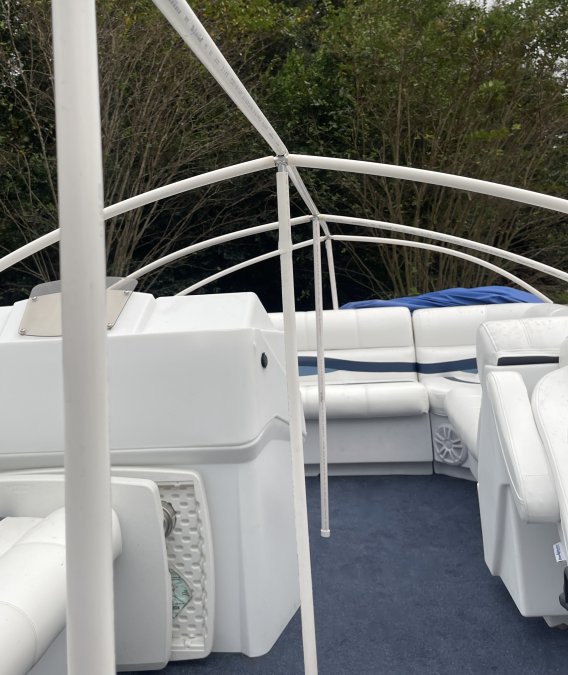
Equally important: your support system. A sagging cover pools water, which drains into boat seats and creates standing moisture. A proper support frame keeps your cover elevated and taut, preventing water collection and ensuring air circulation underneath.
Shrink-Wrap vs. Canvas: Which Works Best
Shrink-wrap creates an airtight seal, trapping condensation inside and risking mold damage. Canvas covers breathe, shedding water while allowing moisture to evaporate. For winter storage lasting 4-6 months or longer, breathable canvas is the smarter choice for protecting pontoon furniture from winter damage.
Building a Support Frame to Prevent Water Pooling
A sagging cover pools water and allows it to seep into seams and reach your furniture. Build a proper support frame with poles spaced 3-4 feet apart to create a dome shape that sheds water. Combined with a floor-supported system that sits on the pontoon deck, you have a strong, reliable solution to keep your pontoon boat dry and secured.
Prevent Mold on Boat Seats With Moisture Control
Prevent mold on boat seats with active moisture management: ensure ventilation by leaving small gaps at cover edges or installing vent ports, use desiccant packs inside the cabin (replace every 4-6 weeks), and inspect every 4-8 weeks for condensation or visible mold. Catching mold early prevents it from spreading to upholstery.
Manage Ventilation and Condensation During Winter
Condensation forms when warm interior air meets cold exterior air. The severity of condensation risk depends heavily on your regional climate, so a one-size-fits-all ventilation strategy won’t work.
How Climate Affects Condensation Risk
Humid coastal regions: High ambient humidity requires active airflow and dehumidification. Cold, dry northern climates: Freeze-thaw cycles create condensation; focus on preventing temperature swaps. Moderate inland climates: Adjust ventilation seasonally as moisture profiles change.
Ventilation Strategy for Your Climate
For humid coastal storage: Install vent ports on opposite sides (bow and stern), spaced 6+ feet apart. Leave cover edges loose (2-3 inches gap) for continuous air escape. Run a portable dehumidifier targeting humidity below 60%, checking every 2-4 weeks. Place desiccant packs throughout the cabin, replacing every 4-6 weeks. Solar-powered fans are also a great choice.
For cold, dry northern storage: Install vent ports and open the cover on mild days (40°F+) to release warm interior air.
Monitor Humidity Levels Actively
Invest in a basic humidity meter ($15-30) and check levels every 2-4 weeks. Target below 60% humidity; above 65% requires increased ventilation or dehumidification. Below 40% is acceptable, focus on preventing freeze-thaw condensation instead.
Ventilation Setup: Practical Installation
Stick-on vent ports: Clean cabin exterior, apply adhesive-backed ports on opposite sides 6+ feet apart, press firmly. Cost: $20-40. Through-hull fittings: Drill 1.5-inch hole, install stainless steel fitting with seacock. Cost: $50-100 plus installation. Cover gap ventilation: Leave 2-3 inch gaps at bow and stern for natural convection.
What to Do If Condensation Appears
If you find heavy condensation: wipe down immediately, increase ventilation, run a dehumidifier for 2-3 weeks, check for mold and treat with 10:1 water-to-bleach solution, and inspect the cover for tears. Persistent condensation despite ventilation indicates either a climate mismatch or cover failure.
Stop Rodents and Pests From Damaging Your Pontoon
Rodents can destroy cushions, chew wiring, and contaminate your boat in a single winter. Pest damage is entirely preventable with a multi-layered approach.
Seal Entry Points Before Covering Your Boat
Rodents enter through openings as small as a dime. Seal entry points: through-hull fittings, cable penetrations (wrap with steel wool then seal), ventilation openings (install 1/4-inch hardware cloth), seams and cracks, and propane lockers. Use marine-grade sealant combined with steel wool for a permanent barrier.
Remove All Food and Organic Material
Remove all food, snacks, and beverage containers. Empty trash cans and wipe surfaces. Check under cushions and behind panels for forgotten food. Remove organic materials (paper, cardboard, fabric scraps) that rodents use for nesting. Inspect insulation for damage and replace if needed.
Install and Monitor Rodent Traps Strategically
Place traps on the dock near your boat and along the perimeter on the ground. Use snap traps (bait with peanut butter or nesting material) or electronic traps. Do not use loose poison pellets inside the boat. Check traps every 2-4 weeks and rebait if needed.
Use Deterrents as a Secondary Layer
Use deterrents in combination with sealing and traps: ultrasonic devices (place inside cabin and near exterior), peppermint oil or ammonia-soaked cotton balls (replace every 4-6 weeks), or predator urine (spray around perimeter). These are inexpensive but should not replace physical barriers and traps.
Inspect for Pest Activity During Off-Season Checks
During your regular maintenance visits (every 4-8 weeks), spend 5 minutes checking for pest signs:
- Droppings: Fresh droppings are dark and moist; old droppings are gray and crumbly. Location indicates where rodents are active.
- Chewed material: Look for bite marks on cushions, wiring insulation, or wooden trim.
- Nesting material: Shredded paper, fabric, or insulation indicates active nesting.
- Grease marks: Rodents leave dark smudges along walls and beams as they travel.
- Odor: A musty or ammonia-like smell suggests active rodent presence.
Common Winter Storage Mistakes to Avoid
The biggest mistake is skipping the cleaning step. Dirty upholstery plus moisture equals mold. No shortcut around this.
Off-Season Maintenance Checks for Pontoon Furniture
Schedule maintenance checks every 4-8 weeks during winter storage. These don’t need to be lengthy, 30 minutes per visit is enough.
|
Maintenance Task |
Frequency |
What to Look For |
|---|---|---|
|
Cover inspection |
Every 4-8 weeks |
Tears, sagging, pooled water |
|
Condensation check |
Every 4-8 weeks |
Moisture on windows and upholstery |
|
Mold inspection |
Every 4-8 weeks |
Visible growth on seats or cabin |
|
Pest monitoring |
Every 2-4 weeks |
Droppings, chewed material, traps triggered |
|
Support frame check |
Every 8-12 weeks |
Rust, bending, loose fasteners |
|
Humidity monitoring |
Monthly |
Levels above 60% indicate ventilation issues |
Frequently Asked Questions
What’s the best way to prevent mold on boat seats during winter storage?
Start by cleaning vinyl upholstery thoroughly with a marine-grade cleaner, then apply a vinyl protectant. The key is moisture control: use a breathable storage cover, install support poles to prevent water pooling, and ensure ventilation around the boat. Check seats weekly during storage to catch condensation early. Mold spores thrive in damp, stagnant environments, so air circulation is critical. Consider placing moisture-absorbing materials like desiccant packets inside cushioned areas to wick away excess humidity.
Should I remove pontoon cushions for winter storage?
Removing cushions is the safest approach if you have secure indoor storage space. Cushions are vulnerable to mold, UV damage, and moisture absorption. If you must leave them on the boat, ensure they’re completely dry, apply a vinyl protectant, and use a support frame that elevates your storage cover to prevent water pooling on surfaces. Removable cushions should be stored indoors in a climate-controlled space, away from direct sunlight and humidity. This prevents long-term storage damage and extends upholstery life significantly.
Is it necessary to use a support system under a pontoon boat cover?
Yes, a Pontoon Boat ULTIMATE Canvas Solution support system is essential for winter storage. Without one, snow load and standing water create dangerous pooling, which damages your canvas cover, promotes mold growth, and stresses the boat’s frame. A Pontoon Boat Canvas Solution cover support system keeps the cover elevated and taut, allowing water and snow to shed properly. This preventative maintenance protects your furniture, reduces mold spores, and extends cover life. Support poles with arch-style frames distribute weight evenly and prevent the sagging that leads to moisture accumulation.
Can I use Armor All on my boat seats during winter?
Armor All is designed for automotive interiors and isn’t formulated for marine vinyl or the specific demands of winter storage. Marine vinyl protectants are engineered to resist salt air, UV exposure, and moisture—conditions Armor All doesn’t address. Use a marine-grade vinyl conditioner or UV protectant specifically rated for boat upholstery. These products provide better water shedding, mildew prevention, and durability in harsh marine environments. Apply your chosen marine protectant before covering your boat for winter.
c