
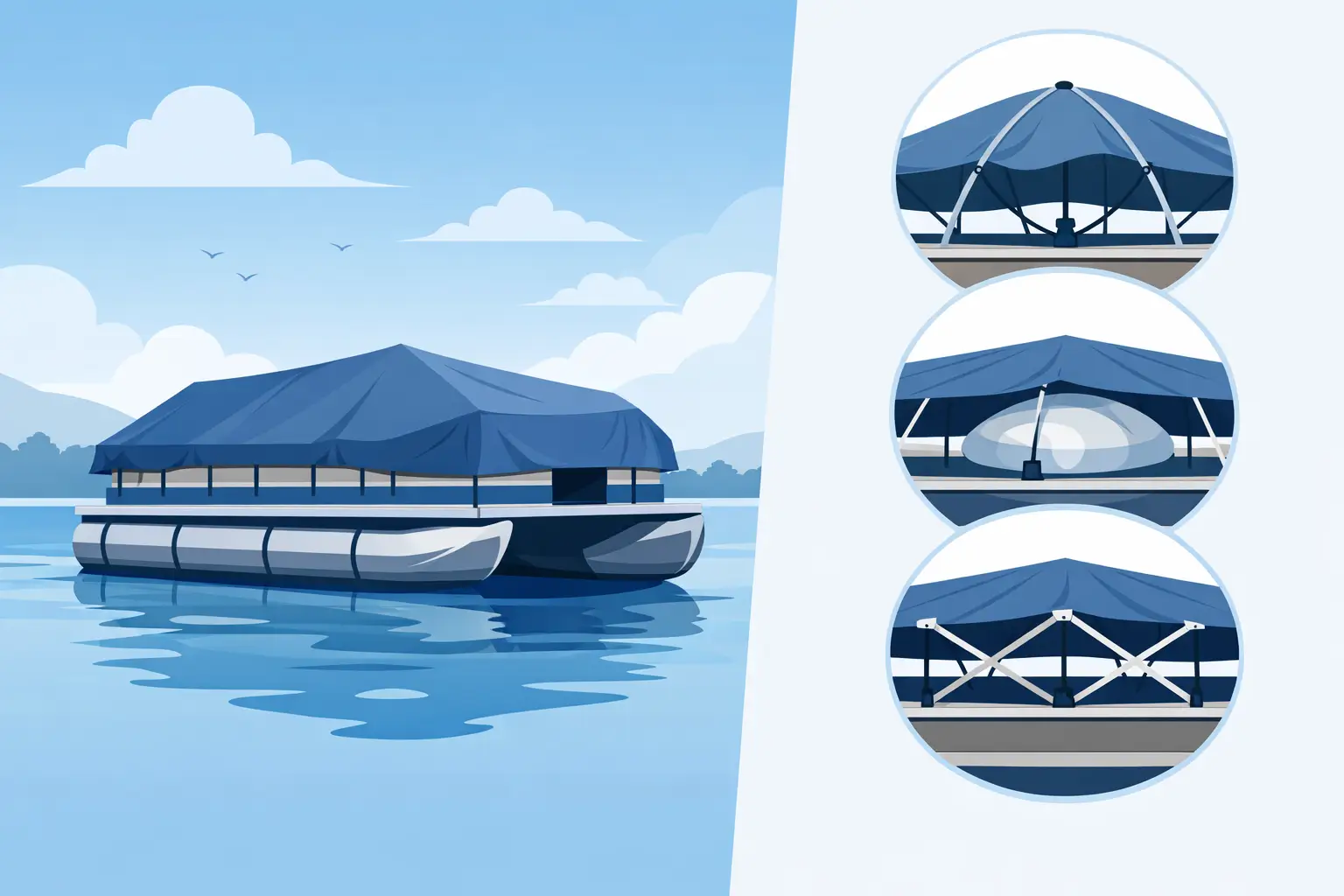
If you have ever walked down to your boat after a hard rain and found your cover sagging like a wet tarp over your furniture, you already know why so many owners start searching for a pontoon cover support poles alternative. The standard center pole setup is common because it is cheap and familiar. That does not mean it is the best way to protect a pontoon that spends weeks or months sitting in the weather.
A pontoon is not shaped like a runabout, and that matters more than most cover systems seem to admit. Wide decks, open seating layouts, long spans, and rail geometry create a different support challenge. A single pole, or even a few poles, can lift part of the cover, but it often leaves low spots, shifting pressure points, and too much unsupported canvas. That is when rainwater pools, debris collects, and the cover starts working against you instead of for you.
Why owners look for a pontoon cover support poles alternative
Most pontoon owners are not trying to reinvent storage. They just want a cover that stays tight, sheds water, and does not leave them babysitting the boat after every storm. Traditional support poles can help in mild conditions, but they come with trade-offs.
The biggest issue is that poles create point support instead of broad support. In plain terms, they push up one spot while the surrounding fabric still has room to sag. On a pontoon cover, that can mean multiple valleys between raised areas. Water is heavy, and once it starts collecting, the problem gets worse fast. The weight stretches fabric, stresses seams, and can transfer moisture where you do not want it.
There is also the setup frustration. Poles tip, straps loosen, bases shift, and cover fit changes from one season to the next. If your boat is stored outdoors for extended periods, you need a system that keeps doing its job after wind, temperature swings, and repeated rain. That is where many generic pole kits fall short.
What actually works better than support poles?
The best pontoon cover support poles alternative is a support system that creates a dome across the cover instead of relying on a few vertical pressure points. That distinction matters. A dome shape encourages water runoff across a larger area, reduces sagging between supports, and helps keep the cover tighter from end to end.
For pontoon owners, rail-mounted support systems are usually the better answer because they use the boat’s existing geometry instead of fighting it. Rather than standing loose inside the deck and pushing up from below, these systems anchor to the rails and create structure where a pontoon cover needs it most. The result is more consistent support, better drainage, and less chance of the cover collapsing into low spots.
This is also where pontoon-specific design separates itself from generic marine hardware. A product designed specifically for pontoon geometry can span the width more effectively and keep support where the canvas naturally wants to sag. That is a major upgrade over one-size-fits-all poles that were never really built with pontoons in mind.
The problem with generic solutions on a pontoon
A lot of boat accessories are sold as universal. That sounds convenient until you install them on a pontoon and realize universal usually means compromise. Support poles are a good example. They are often adapted from general boat storage setups, not engineered around the real dimensions and rail layouts of pontoon boats.
On a pontoon, wide beam and long open deck sections make generic pole placement tricky. Put a pole in the wrong spot and it interferes with seating, presses awkwardly against the cover, or simply fails to support the surrounding span. Add wind into the mix and you can end up with shifted poles, rubbing fabric, or uneven tension that shortens cover life.
That does not mean every pole system is useless. If you store your boat short term, keep it under a roof, or only need a temporary lift point, a basic pole may be enough. But if your goal is long-term outdoor protection, especially through repeated storms, tree debris, and seasonal storage, most owners benefit from moving beyond poles.
What to look for in a true pontoon cover support poles alternative
A better system should do more than lift the canvas a few inches. It should improve the entire way your cover performs.
First, look for broad structural support. The goal is not just height. The goal is shape. You want a support design that creates a clear high point and steady slope so rain and leaves are less likely to sit on the cover.
Second, look for a secure mounting method that does not depend on constant adjustment. Freestanding poles can move. A system that attaches to the pontoon rails is typically more stable and more predictable in changing weather.
Third, installation matters. Many pontoon owners want better protection, but they do not want to drill holes, fool with glue, or turn a weekend project into a full hardware retrofit. A smarter solution should be DIY-friendly and non-invasive.
Finally, pay attention to materials. Lightweight and flimsy is not an advantage if it bends under load or fails after a season in the elements. Heavy-duty aluminum components and purpose-built hardware usually hold up better over time, especially for owners who store their boat outside.
Why rail-mounted dome systems make more sense
A rail-mounted dome support system solves the core weakness of poles by distributing support across the cover instead of concentrating it in isolated spots. That means less sagging, better runoff, and fewer problem areas where standing water can settle.
It also makes practical sense for pontoon owners because it respects the boat you already own. You invested serious money in your furniture, flooring, canvas, and finishes. The support system protecting that investment should not require drilling into the boat or improvising with straps and unstable bases.
That is why purpose-built systems have become such a strong upgrade path. At Pontoon Boat Solutions, LLC, the focus is on products designed specifically for pontoon geometry, and that matters here. A rail-mounted canvas support system built for pontoons creates a stronger dome structure, keeps covers tighter, and helps prevent the pooling and debris buildup that can age your cover and your interior faster than expected.
Is a pontoon cover support poles alternative worth it?
For many owners, yes, especially when the boat sits outside for weeks at a time. The value is not only in better water runoff. It is also in reduced hassle. A tighter, better-supported cover usually means fewer trips to check pooling after storms, less chance of mildew-friendly moisture hanging around, and better protection for seating and finishes.
The real answer depends on how you use and store your pontoon. If your boat lives on a lift with a roof overhead, a simple setup may be all you need. If it is parked outside through spring storms, summer downpours, falling leaves, and off-season weather, upgrading to a stronger support system becomes a lot easier to justify.
It also depends on the cover itself. Even a quality cover can only perform as well as the structure beneath it. When support is poor, water pooling and fabric stress can wear out a good cover early. Better support helps your cover do the job you bought it to do.
Choosing the right alternative for your boat
Start with the basic question: do you want a temporary workaround, or do you want a long-term protection solution? If you are tired of adjusting poles, dealing with puddles, and worrying about what the next storm will leave behind, a pontoon-specific support system is usually the smarter move.
Measure your storage reality honestly. Think about how often your boat sits uncovered by any roof, how much rain and debris your area gets, and whether you are storing for days, weeks, or an entire off-season. The harsher the exposure, the more important support design becomes.
A good alternative should feel like it belongs on a pontoon, not like a generic part adapted to fit. That is the difference between a product that merely props up a cover and one that actively helps protect your investment.
Your cover should not become a shallow pool every time the weather turns. If your current setup keeps creating sagging, puddles, or constant maintenance, that is your sign to stop settling for poles and choose a solution built for the way pontoons are actually stored.