
Last Updated: October 25, 2026
Quick Summary
Taylor Made and Vic’s Marine both offer aluminum pontoon cover support systems with adjustable height, but both require drilling into your boat and rely on vertical pole rigidity. Taylor Made poles perform adequately in the first season on smaller boats but bow under heavy snow load on larger pontoons, while Vic’s Marine poles often sag within the first season on 28-foot boats in snow country, making no-drill floor-supported systems a better alternative for preserving boat integrity and preventing water pooling.
- Taylor Made and Vic’s Marine poles both use aluminum construction with adjustable height settings and require drilling for installation.
- Taylor Made poles show adequate performance on smaller boats during the first season but experience bowing after heavy snow load on larger pontoons.
- Vic’s Marine poles frequently experience sagging within the first season on 28-foot boats in snow climates, with warranty claims often slow through retail channels.
- No-drill floor-supported systems eliminate drilling damage, distribute weight across the entire cover, and allow easy seasonal removal without permanent boat modifications.
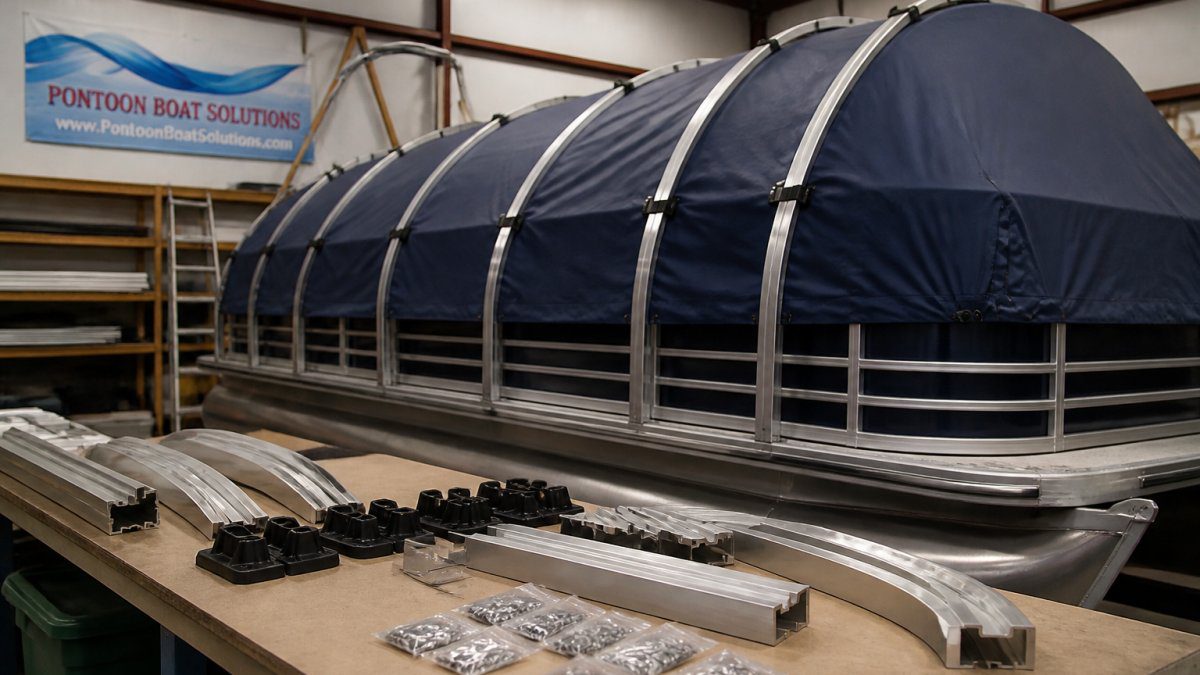
- Pontoon Boat Solutions offers a patent-pending system using solid aluminum Arch-Makers designed specifically for pontoon geometry without screws, nuts, bolts, glue, or drilling.
Table of Contents
- Why Pontoon Cover Support Matters for Your Boat
- What to Look for in a Pontoon Boat Cover Support Pole
- Taylor Made Support Systems: Strengths and Limitations
- Vic’s Marine Support Systems: What Owners Report
- How to Stop Pontoon Cover Sagging Without Drilling
- Pontoon Cover Water Pooling Prevention: Installation Best Practices
- Pontoon Cover Support Installation: DIY vs Professional Setup
- Choosing Your Pontoon Cover Support System
- Frequently Asked Questions
Why Pontoon Cover Support Matters for Your Boat
A sagging pontoon cover isn’t just an eyesore, it’s a threat to your entire boat investment. Water pools in the center, creating pockets where mold thrives and canvas deteriorates. Your furniture underneath gets damaged. The cover itself weakens faster. What starts as a minor cosmetic issue becomes an expensive repair or replacement.

Most boat owners don’t realize how critical proper support is until damage appears. By then, you’re looking at replacing cushions, dealing with mold remediation, or buying a new cover entirely. A solid pontoon cover support system prevents all of this. It keeps your canvas elevated, water drains properly, and your furniture stays protected year-round.
The real question isn’t whether you need support, it’s which system works best for your boat. That decision comes down to understanding what’s available and what actually delivers results. Two names keep coming up in this conversation: Taylor Made and Vic’s Marine. Both have products on the market. Both claim to solve the sagging problem. But they work very differently, and the choice matters.
What to Look for in a Pontoon Boat Cover Support Pole
Not all support poles perform equally. Understanding these criteria helps you evaluate any option you’re considering. Explore alternative pontoon cover support pole options to compare different solutions available for your boat.
Strength and material quality matter most. Aluminum resists rust in marine environments better than steel. Solid aluminum construction outlasts hollow tubes. The pole needs enough rigidity to support canvas weight plus standing water without bowing.
Height adjustability is essential. Pontoon boats vary in beam width and cabin height. A fixed-height pole won’t work universally. The best systems let you customize height to match your specific boat geometry.
Installation method affects long-term durability. Drilling holes into your pontoon creates weak points where water infiltrates and corrosion starts. No-drill systems preserve your boat’s structural integrity. They also make seasonal removal and storage simpler.
Corrosion resistance determines lifespan. Salt air, rain, and UV exposure break down materials quickly. Anodized aluminum or stainless steel hardware resists these forces. Cheap poles rust within a season or two.
Ease of use separates practical solutions from ones that sit unused. If installation takes hours and requires tools you don’t have, you’ll skip it. The best systems go up in an afternoon without special equipment.
Taylor Made Support Systems: Strengths and Limitations
Taylor Made has been making marine products for years. Their support poles are widely available at marine retailers and online. They offer a familiar name and established distribution network that many boat owners recognize.
Their poles typically use aluminum construction with adjustable height settings. Installation involves drilling into your boat’s frame or railings to secure the poles. The approach is straightforward, measure, drill, install. Replacement parts are relatively easy to find if something breaks.
The limitation is the drilling requirement itself. Every hole you put in your pontoon is a potential entry point for water and corrosion. Over time, even sealed holes can fail. The installation also demands precision. Drill in the wrong spot or at the wrong angle, and you’ve compromised your boat’s integrity permanently.
Many owners report that Taylor Made poles work adequately during the first season. Performance varies significantly based on boat size and cover weight. Wider beams create more sagging pressure than narrow ones. Heavier canvas covers stress the poles more than lighter materials.
The support channels and response times from Taylor Made are typical for the industry. You can reach them through their website or phone.
Taylor Made and Vic’s Marine poles share similar construction but differ in key performance areas.
| Feature | Taylor Made | Vic’s Marine |
|---|---|---|
| Material | Aluminum with adjustable height | Aluminum with adjustable height |
| Installation method | Drilling required | Drilling required |
| Performance on smaller boats | Adequate during first season | Acceptable for basic applications |
| Performance on larger boats | Bowing after heavy snow load | Sagging within first season |
| Replacement parts | Relatively easy to find | Limited availability |
| Customer support | Website and phone contact | Through retail channels only |
| Warranty claims | Standard industry response | Often slow through retailers |
Vic’s Marine Support Systems: What Owners Report
Vic’s Marine also manufactures pontoon cover support products. Their systems use aluminum poles with similar height-adjustment features to Taylor Made. They’re positioned as a budget-friendly alternative with competitive pricing at major marine retailers.
Vic’s Marine poles follow the same installation approach, drilling is required. Their customer service operates through standard marine retail channels. Response times depend on where you purchase, which adds an unpredictable layer to support quality.
Owner feedback reveals mixed results. Some users report their Vic’s Marine poles holding up well for basic applications. Others describe premature bowing after moderate snow load or heavy rain pooling. The difference often comes down to boat size and climate. A 20-foot pontoon in a mild climate might see acceptable performance. A 28-foot boat in snow country frequently experiences sagging within the first season.
Warranty claims and returns through Vic’s Marine can be slow. Since they sell primarily through retailers, you’re often dealing with the retailer’s return policy rather than direct manufacturer support.
The core issue with Vic’s Marine poles, like Taylor Made, is that drilling weakens your boat. Both systems also rely on pole rigidity to handle all the support load. Wider pontoons with heavier covers push these poles beyond their design limits.
How to Stop Pontoon Cover Sagging Without Drilling
The no-drill approach solves the fundamental problem with traditional support poles. Instead of drilling into your boat, a floor-supported system creates structure from underneath. This preserves your boat’s integrity while providing superior support distribution.
The mechanics are different. Rather than relying on vertical poles to hold weight, a floor-supported system uses a dome-shaped frame that distributes pressure across the entire cover. Water can’t pool because the cover is elevated uniformly.
Installation is simpler. You position the support frame inside your boat, adjust height to match your cover, and secure the canvas over top. No measuring twice. No drilling holes. No permanent modifications. The entire process takes an afternoon.
Seasonal removal is easy. When you need to use your boat or store it differently, you simply lift out the support frame. There’s no damage to undo. No holes to seal.
Material durability extends lifespan. Heavy-duty aluminum construction resists marine corrosion. The design prevents stress concentration at fastening points because there are no fastening points. This means your support system lasts through multiple seasons without weakening.
Pontoon Boat Solutions offers a patent-pending system designed specifically for pontoon boat geometry. The solid aluminum Arch-Makers create a custom dome without screws, nuts, bolts, glue, or drilling.
Pontoon Cover Water Pooling Prevention: Installation Best Practices
Water pooling is the visible symptom of inadequate support. Learn detailed strategies for preventing rain pooling on pontoon covers to protect your canvas and furniture from water damage.
Height matters most. Your support system must elevate the cover enough that water naturally drains to the edges.
Uniform support prevents low spots. If your support is stronger on one side than the other, the cover will sag toward the weak side. Water collects in that low spot.
Secure the edges properly. The cover edges need to be tight enough that they don’t sag between support points. Loose edges create valleys where water pools.
Account for seasonal changes. Snow load in winter creates different stress than rain in spring. Your support needs to handle peak load conditions.
U.S. Coast Guard recreational boating safety guidance emphasizes the importance of proper boat maintenance, including cover systems that protect your investment during storage.
Many boat owners make the mistake of installing support too low. They think “as long as water drains eventually, it’s fine.” That’s not fine.
Visit our guide on the best no-drill pontoon cover support systems to explore solutions that eliminate pooling without drilling into your boat.
Pontoon Cover Support Installation: DIY vs Professional Setup
You can install most pontoon cover support systems yourself. The question is whether you should, and whether DIY installation delivers the same results as professional work.
DIY installation advantages include cost savings and schedule flexibility. You work at your own pace without paying labor charges. You understand exactly how your system is set up.
DIY installation risks center on execution. Drilling into the wrong spot, using incorrect fasteners, or misaligning poles can compromise your boat.
Professional installation advantages include expertise and accountability. A professional knows how different boat sizes and cover types affect installation. They have specialized tools and experience troubleshooting problems. If something fails, they’re responsible for correction.
Professional installation costs vary widely. You might pay $200-$500 depending on system complexity and your location. For a $3,000+ pontoon boat investment, professional installation is often worth the cost.
The installation method matters less than the end result. Whether you install it yourself or hire help, your cover needs to be elevated uniformly, water needs to drain, and your boat needs to remain undamaged.
Our article on preventing mold under pontoon boat covers covers maintenance steps that apply regardless of installation method. Proper setup during installation prevents many problems later.
Choosing Your Pontoon Cover Support System
Your decision comes down to what matters most to your situation. Budget, boat size, climate, and your comfort with DIY work all factor in.
The no-drill approach prevents the core problems that drilling systems create. No holes means no corrosion pathways. Floor-supported domes distribute weight better than vertical poles. Seasonal removal is simple. Your boat stays undamaged.
Compare support systems by asking specific questions: Does it require drilling? Can you adjust height to match your boat? Does it create a proper dome shape? How easy is seasonal installation? What material resists corrosion best?
National Marine Manufacturers Association guidance on boat maintenance recommends investing in quality protection systems that match your boat’s specifications and your local climate conditions.
Your pontoon cover support system should work for you, not against you. It should go up easily, keep water moving, and last through multiple seasons. It should protect your boat, not compromise it.
Protecting your pontoon boat investment means making decisions that preserve value while preventing damage. A sagging cover isn’t a minor inconvenience, it’s a gateway to mold, furniture damage, and canvas deterioration.
Frequently Asked Questions
How do Taylor Made and Vic’s Marine pontoon cover supports compare in durability?
Both brands offer aluminum construction designed for marine environments. Taylor Made poles have been on the market longer, while Vic’s Marine emphasizes corrosion resistance in saltwater conditions. Your choice depends on your local climate and how frequently you store your boat.
Can you install a pontoon boat cover support pole yourself without drilling?
Yes. Many modern support systems, including floor-supported designs, require no drilling or permanent modifications to your boat. These systems rest on the pontoon deck and use the boat’s geometry to create an elevated dome. Always follow the manufacturer’s instructions for your specific system.
What causes pontoon cover water pooling, and how do support poles prevent it?
Water pools when canvas covers sag in the center, creating a depression where rain collects. Support poles or arch systems elevate the cover to create a peaked or domed shape, allowing water to run off instead of accumulating. Proper elevation angle and pole spacing are critical, too few supports or incorrect placement will still allow pooling.
How many support poles does a pontoon cover actually need?
Most pontoons need 2-4 supports depending on beam width and cover length. Wider beams need more support points.
