
Last Updated: November 24, 2026
Quick Summary
A dome support system is worth it for pontoon boats when water pooling and cover sagging are costing you money, and you are willing to pay more upfront for a shape that sheds water. Whether it pays off depends on your boat, your storage conditions, and what a failed cover would cost to replace.
- Dome systems spread support across the cover, while pole systems concentrate it at individual points.
- Pole supports can let the cover sag between poles, where water collects in low spots.
- The Arch-Makers are described as screw-free and drill-free, avoiding drilling into the boat.
- Total upfront cost is the purchase price plus installation, compared against cover replacement and water damage.
- Confirm beam width, rail layout, and obstruction clearance before ordering, since fit is not guaranteed.
Table of Contents
- How Dome and Pole Support Systems Compare
- Pontoon Cover Support Poles: How They Work and Where They Fall Short
- Pontoon Boat Cover Support System Reviews: Pros and Cons of Dome Systems
- Pricing, Value, and Break-Even Thinking
- Installation Effort and Fit for Your Pontoon Boat
- Verdict: Which Owners Should Choose a Dome System
- Frequently Asked Questions
A dome support system is worth it for pontoon boats when water pooling and cover sagging are costing you money, and when the buyer is willing to pay more upfront for a shape that sheds water. The short answer depends on your boat, your storage conditions and how much a failed cover would cost you to replace.
The research available for this article does not include published prices, lifespans or measured performance results for dome systems compared with pole supports. Because of that, this guide explains the decision framework rather than claiming a specific return on investment. A common approach is to weigh that benefit against the cost of the system and the cost of cover repairs over time. Pontoon Boat Solutions product page describing the dome design and water runoff claims
How Dome and Pole Support Systems Compare
A dome system spreads support across the cover, while a pole system concentrates it at individual points. Compare Taylor Made and Vic’s Marine support systems side by side to see how two specific brands handle this difference. Pontoon Boat Solutions comparison of dome and pole cover supports
| Factor | Dome System | Pole System |
|---|---|---|
| Support layout | Spread across the cover | Concentrated at each pole |
| Water runoff | Shape is designed to shed water | Depends on pole placement and cover tension |
| Installation | No drilling on the Arch-Makers design | Varies by pole type |
| Documented long-term data | Not found in supplied research | Not found in supplied research |
iBoats Boating Forum discussion of pontoon cover support systems
Pontoon Cover Support Poles: How They Work and Where They Fall Short
Pole supports hold the cover up at set points. Their main weakness is that the cover can sag between the poles, and water can collect in those low spots. Owners who want the poles to work well need to keep the cover tight, which takes attention and adjustment over time.
Watch out: if the cover is not stretched semi-taut between poles, water can pool in the gaps and add weight that pulls the cover further down.
Owners who find poles falling short often look for fixes such as adding supports or tightening the cover. Seven practical fixes for a sagging pontoon cover cover what to try first. A practical starting point is to check the cover after each rain and note where water sits.
Pontoon Boat Cover Support System Reviews: Pros and Cons of Dome Systems
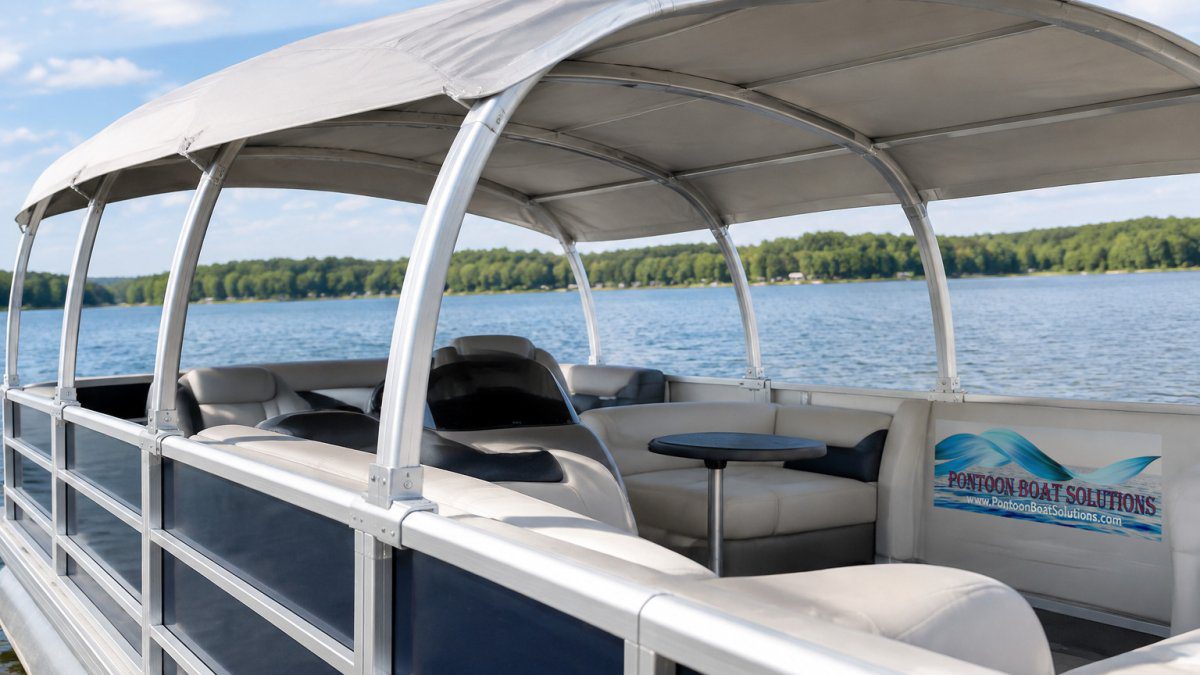
The Pontoon Boat Solutions Arch-Makers use solid aluminum, avoid screws and drilling, and are designed for pontoon boat geometry.
Pros:
- A raised profile intended to encourage water runoff
- No drilling into the boat
- Designed specifically for pontoon boats
Cons:
- Pricing is not listed in the research available for this article
- Dimensions and compatibility details are not provided in the supplied results
- No independent long-term durability data was found
Best for: owners who want a no-drill support and who will check compatibility before buying. See a list of no-drill pontoon cover support systems to compare other options.
Skip if: you need verified price and durability figures before committing.
Review comparing pontoon cover support systems
Pricing, Value, and Break-Even Thinking
Most competing guides stop at “it depends on your budget.” That is not useful when you are standing in a marine store aisle or comparing an online cart. The better approach is to build a total-cost-of-ownership picture across four cost buckets, then compare that against the realistic cost of doing nothing.
Bucket 1, Purchase price of the support system. Because published prices change and vary by configuration, confirm the current figure on the product page or request a quote rather than relying on a number from a forum post.
Bucket 2, Installation cost. The Arch-Makers are designed for DIY installation without drilling. A design that requires drilling, through-bolting, or custom fabrication pushes the job toward a dealer or rigger, and that labor is a real line item. Add the cost of any hardware, sealant, or backing plates the install requires.
Bucket 3, Replacement cover cost. This is the number that drives the whole calculation. A pontoon cover is a large, custom-fit piece of marine canvas, and replacement pricing scales with boat length, beam, and fabric grade.
Bucket 4, Water-damage cost. Standing water on a cover does more than ruin canvas. It adds weight that stresses seams and snaps, it can wick through to upholstery and carpet, and in freezing conditions it can crack or deform the cover and the surfaces beneath.
A simple break-even test. Add Bucket 1 and Bucket 2 to get your total upfront cost. Then estimate the replacement cost of your cover (Bucket 3) and the realistic repair or replacement cost of the interior surfaces most exposed to water (Bucket 4). Divide your upfront cost by the per-season damage cost you expect to avoid. The result is the number of seasons the system must last to pay for itself.
Use-case decision framework.
- Occasional storage, sheltered location: The case for a premium dome system is weakest. A tight cover and a couple of poles may be enough, and the break-even horizon stretches out.
- Year-round outdoor storage in a wet climate: The case is strongest. Pooling happens repeatedly, cover wear accelerates, and the per-season damage cost is high.
- Snow-load storage: A dome or arch shape sheds snow differently than a flat pole-supported cover, and the structural question becomes as important as the price. Confirm the system’s snow-load guidance with the manufacturer.
- Owners who remove the cover frequently: A no-drill, quick-release design earns its premium through setup time saved, not just water protection.
- Budget-constrained buyers: A pole kit plus disciplined cover tension is a legitimate lower-cost path; the trade-off is more frequent adjustment and a higher chance of sag between supports.
Watch out: a break-even calculation built on a guessed cover price is worse than no calculation. Get an actual replacement quote for your boat’s cover size before you run the numbers, and treat any manufacturer’s durability claim as a claim to verify, not a warranty.
Pontoon Boat Solutions product page for current dome system pricing and configuration options
Installation Effort and Fit for Your Pontoon Boat
The Arch-Makers are described as screw-free and drill-free, which removes the most common installation worry. But “no drilling” is not the same as “fits your boat.” The fit questions below are the ones that most often cause a return or a frustrating install, and they are the questions most competing guides skip.
Fit checklist, gather these before you order:
- Beam width. Measure the widest point of your pontoon deck, outside rail to outside rail. Compare that to the system’s stated fit range. A system sized for a narrow beam will not span a wide deck, and one sized for a wide beam may not tension correctly on a narrow boat.
- Rail layout and rail height. Note whether your rails are continuous or interrupted by gates, cleats, and bimini mounts. A rail-mounted system needs a clear, straight run of rail to clamp to. Measure rail height above the deck, because that sets how much arch clearance you get under the cover.
- Boat length and number of support points. Longer boats need more support points to keep the cover from sagging between arches. Confirm how many arches or supports the kit includes for your length, and whether you can add more.
- Cover shape and fit. A dome or arch system works best under a cover with enough slack and a shape that follows the arch. A very tight, flat-cut cover may not accommodate the raised profile without stress at the seams. Check whether your cover is designed for use over a support frame.
- Clearance for bimini tops, ski tow bars, and furniture. Measure the height of anything that stays up under the cover. The arch must clear those obstructions or the cover will tent over them and create new low spots.
- Floor-supported versus rail-mounted. Floor-supported designs rest on the deck and depend on a clean, flat mounting surface; rail-mounted designs clamp to the rail and depend on rail condition and access. Pick the one that matches your deck and rail setup, not the one that is cheaper.
Installation effort, realistically. A no-drill system is a one-person job for most owners, but budget the time for measuring, test-fitting, and adjusting tension rather than assuming a five-minute setup. The steps are typically: assemble the frame, position it on the rail or deck, set the arch height, drape the cover, and then adjust tension so water runs off rather than pooling at the arch peak or in the valleys between arches. Follow a step-by-step DIY installation guide to see how much effort a self-install really takes.
Where installs go wrong.
- Tension set too loose. The cover sags into the valleys between arches and recreates the pooling problem the system was meant to solve.
- Tension set too tight. Seams and snap fittings take the load, and the cover wears prematurely at the arch contact points.
- Rail clamps over a curved or interrupted rail. The clamp does not seat fully, and the arch shifts in wind.
- Arch height mismatched to cover shape. The cover tents at the peak and pools at the edges instead of shedding.
Watch out: if the product page does not list a fit range for your beam width and rail layout, contact the manufacturer directly before ordering, a support system that does not fit your boat is a return, not a fix.
!A pontoon owner in a driveway fitting a curved aluminum support across a canvas cover on a pontoon boat, sunlight on the deck rails

Measure your boat’s beam width, rail height, and the height of any fixed obstructions before buying, then compare those numbers with the product page. If the page does not list the fit range for your beam, contact Pontoon Boat Solutions directly before purchase.
Verdict: Which Owners Should Choose a Dome System
A dome support system is worth considering if your cover already pools water, if you want no-drill installation, and if you are comfortable confirming fit before you buy. It is harder to justify if your cover is new, your storage is sheltered, or you need verified price and durability data to make the decision.
Start with the fit and break-even questions above, then review the Pontoon Boat Solutions product line for current options.
Frequently Asked Questions
Is a dome support system better than support poles for a pontoon boat?
Dome systems are designed to hold the cover in a raised arch. Pole systems are cheaper and work well for many owners, especially if the cover is stretched taut. No independent side-by-side testing has measured which lasts longer or prevents more pooling, so the right choice depends on your boat width, storage conditions, and how much you are willing to spend to avoid standing water.
Can a pontoon boat cover support system prevent water from pooling?
Check the product details and your cover’s fit before buying.
How do you install a floor-supported dome system on a pontoon boat?
Most floor-supported systems are installed by positioning the support pieces on the deck, fitting them under the cover, and tightening the cover over the top. Pontoon Boat Solutions markets its Arch-Makers as screw-free and drill-free, so no holes are needed in the boat. Pricing depends on quantity, dates, and delivery. Contact the company for current prices and a fit recommendation.
What should you look for when buying a pontoon cover support system?
Check the support’s materials, how it attaches to the boat, whether it fits your beam width, and whether it works with your existing cover. Confirm the return policy before ordering, since you cannot touch the product before buying. Compare the upfront cost against what you spend on replacing a sagging or damaged cover, and read customer reviews for long-term durability reports, which are more useful than marketing claims.
