
Last Updated: November 5, 2026
Quick Summary
The best pontoon boat covers for heavy snow combine 1200-denier waterproof and breathable fabric with a floor-supported arch system that holds the canvas in a raised dome, so snow slides off instead of pooling. Fit must match your boat’s length and beam, and you should clear wet snow before it refreezes into ice.
- A 1200-denier polyester cover is a common benchmark for pontoon winter storage.
- A flat cover sags and collects snow no matter how strong the fabric is.
- Arch spacing and peak height decide whether the canvas sheds snow or bellies under it.
- Size up when your boat falls between sizes, then let the support frame take up the slack.
- Clear snow with a soft-bristle broom or snow rake, never a metal shovel or scraper.
Table of Contents
- Pontoon Boat Covers for Heavy Snow: What Actually Decides Performance
- Heavy Duty Winter Boat Covers Compared: Fabric, Denier, and Snow Load
- Side-by-Side: Pontoon Cover Options for Heavy Snow
- Pontoon Boat Cover Support System: Why Frames Beat Tight Fabric
- Pontoon Boat Covers While Docked: Mooring, Ventilation, and Tie-Down
- Pontoon Boat Winter Storage: Fit, Sizing, and Snow Shedding
- Choosing Your Heavy-Snow Cover and Support Setup
- Frequently Asked Questions
Pontoon Boat Covers for Heavy Snow: What Actually Decides Performance
A pontoon boat cover only survives a heavy winter when three things work together: a heavy-duty fabric that sheds snow, a fit that matches your boat’s length and beam, and a support system that holds the cover in a raised dome so snow slides off instead of piling up. Skip any one of those and you get the same result every February: sagging canvas, pooled meltwater, and mildew working its way into your furniture.
At Pontoon Boat Solutions, we build hardware for exactly this problem. Below, we compare the real options, from 1200-denier covers to no-drill frame systems, so you can pick a setup that holds up in a genuine snow belt.
The cover is only half the system. A tight fabric pulled over a flat deck has nowhere to shed snow, it stretches, sags, and collects weight until something gives.
Heavy Duty Winter Boat Covers Compared: Fabric, Denier, and Snow Load
Heavy-duty winter boat covers are rated mainly by fabric denier, coating, and how the material handles accumulated snow weight. Denier measures thread thickness, and higher denier generally means stronger fabric that resists stretching under load.
Denier and Fabric Strength
Denier tells you how much fabric strength you are buying. A 1200-denier polyester cover is a common benchmark for pontoon winter storage.
Lower-denier fabric costs less and works fine for dust and summer sun. Under snow load, thin fabric stretches, then sags, then pools.
Waterproof, Breathable, and UV-Resistant
Waterproof and breathable sound like opposites. They are not. A waterproof coating keeps rain and meltwater out, while breathable fabric lets trapped moisture escape so condensation does not turn into mildew on your seats. UV-resistant treatment matters for the years a cover spends in the sun between winters.
Watch out: a fully waterproof cover with no breathability traps moisture underneath and can grow mold even while the boat stays dry from above.
Side-by-Side: Pontoon Cover Options for Heavy Snow
Here is how the main cover options stack up on the specs that matter for snow, based on manufacturer and retailer listings.
| Cover | Fabric | Fit Stated | Snow-Load Claim | Price Stated |
|---|---|---|---|---|
| Seal Skin Elite Pontoon Cover | 1200-denier, waterproof and breathable | Not listed in available details | Handles snow weight without stretching | Not listed |
| Budge P-1200-1 | 1200-denier, waterproof, UV-resistant | 20 to 24 feet | Not stated | Not listed |
| Northstar Products Winter Cover | Not specified | 16, 18, and 22 feet | Not stated | $425, $435, $465 |
| Taylor Made Trailerite | Not specified | Pontoon-specific | Not established | Not listed |
Pontoon Boat Cover Support System: Why Frames Beat Tight Fabric
A pontoon boat cover support system holds the canvas in a raised dome so snow and rain slide off instead of collecting in low spots. Tight fabric alone cannot do this: pulled flat, it creates the exact sag that pooling needs.

Snow accumulates where the canvas is flat or concave. A dome gives every part of the cover a downhill path to the rails, so fresh snow slides before it can compact and refreeze.
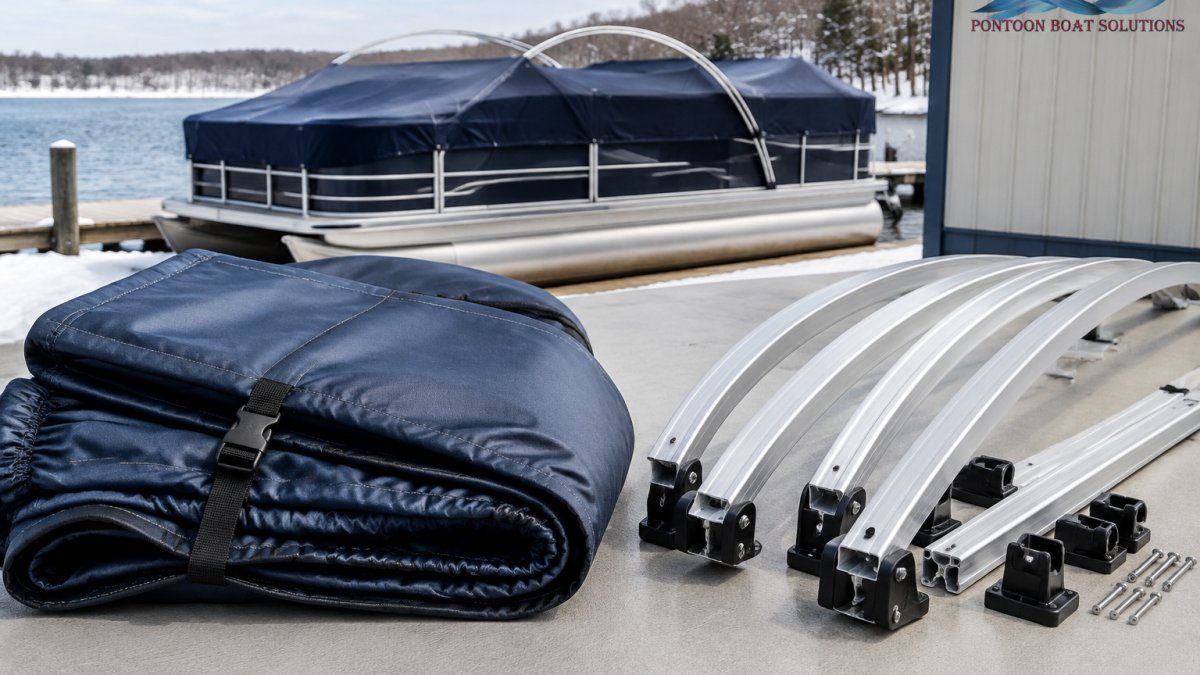
Our approach at Pontoon Boat Solutions uses heavy-duty solid aluminum Arch-Makers to create a custom, floor-supported dome that follows the pontoon’s geometry, with no screws, nuts, bolts, glue, or holes to drill.
If you want to see the specific no-drill system in detail, the Best No Drill Pontoon Cover Support System breaks down how the components fit together.
Support Frame Design and Spacing
Arch spacing is the difference between a dome and a sag. Place arches along the deck so the canvas holds a continuous slope from the centerline to the rails, with enough arches that no span can belly under wet snow.
Height matters as much as spacing. Raising the peak increases the slope angle, and tie-downs and frame anchoring have to scale with peak height.
Two components make that geometry practical. The 6 Arch Maker is the arch component itself, and the Pontoon Boat Canvas Solution 6 Rise With Aluminum 5 Way Extension Kit adds a six-inch rise so you can build the peak height you need for your beam width. The extension kit is what lets you tune slope without changing arch count, useful when a wide beam needs a taller center to keep the same shedding angle as a narrower boat.
Frame material and footing deserve the same attention. A floor-supported design spreads the load onto the deck rather than into the rails or canvas.
Pontoon Boat Covers While Docked: Mooring, Ventilation, and Tie-Down
Pontoon boat covers while docked face a different test than trailered storage. Wind, shifting water levels, and constant moisture mean ventilation and tie-down security matter as much as snow shedding.
Ventilation prevents condensation from collecting under the canvas: keep vents clear, or leave a small gap at the lowest point so moist air can escape. Tie-down straps should be snug but not drum-tight, and every strap should run to a secure point rather than wrapping around a cleat at an angle that chafes.
For docked boats, check the cover after every storm. Snow that slides off during the day can refreeze into ice at the low edge overnight, and that ice adds weight exactly where the fabric is weakest.
Pontoon Boat Winter Storage: Fit, Sizing, and Snow Shedding
Correct fit is measured, not guessed. Match the cover to your boat’s length and beam, and confirm the cover is designed for pontoon geometry rather than a generic V-hull shape. A cover that fits a V-hull will bridge the pontoon’s wide, flat deck and leave long unsupported spans that collect snow, the opposite of what a winter cover needs.
How to Measure a Pontoon for a Winter Cover
Measure before you shop, and write the numbers down. Length runs from the tip of the bow to the back of the stern, including any outboard or sterndrive the cover is meant to enclose, note whether the manufacturer’s length rating includes the engine. Beam is the widest point across the deck, not the width of the tubes at the waterline. Rail and console height determine how much rise the cover needs to clear the furniture without tenting on it.
Sizing by boat length is the starting point. If your boat sits between standard sizes, size up rather than down, then use the support frame to take up the slack. A slightly large cover over a proper dome sheds snow better than a tight cover stretched flat, because the slack becomes slope instead of stress.
For fit guidance and storage cover ideas that go beyond length alone, our pontoon boat storage cover ideas walk through matching cover style to your winter conditions.
Snow Load and Safe Accumulation Limits
No consumer pontoon cover publishes a snow-load rating in pounds per square foot, so you have to manage accumulation rather than trust a number.
Use a soft-bristle broom or a snow rake with a foam or plastic edge, and push snow down the slope rather than pulling it across the canvas. Never chip ice off with a metal shovel or scraper; a pinhole in a waterproof coating becomes a leak that soaks the furniture you were protecting.
Snow shedding depends on slope. A cover peaked at the centerline and sloping steadily to both rails will release snow on its own in most conditions. A flat cover will not, no matter how strong the fabric. The combination that works is a measured fit, a dome with enough arches to keep every span short, and a clearing routine that removes wet snow before it refreezes.
Watch out: leaving a small accumulation to “melt on its own” is how covers fail, daytime meltwater runs to the low edge, refreezes overnight, and adds weight exactly where the fabric is weakest.
Choosing Your Heavy-Snow Cover and Support Setup
Pick your cover by fabric first, then solve the support problem, then confirm the fit. That order prevents the most common and most expensive mistake: buying a strong cover and letting it sag.
- Fabric: Choose 1200-denier, waterproof and breathable material for real snow country.
- Support: Use a floor-supported arch system that creates a continuous dome, not one or two poles.
- Fit: Match length and beam, and size up when you are between sizes.
- Security: Use snug tie-downs and keep ventilation open.
- Maintenance: Inspect after every storm and clear ice from the low edges.
Once your cover and frame are set, protecting the interior is the payoff. Our guide to protecting pontoon furniture from winter damage covers the steps that keep seats and carpet in shape through the off-season.
Heavy snow exposes every weak point in a winter setup, and the fix is rarely a thicker cover alone. It is a cover held in a proper dome so snow never gets the chance to pile up. Pontoon Boat Solutions builds a patent-pending, no-drill system around heavy-duty solid aluminum Arch-Makers that keeps your canvas secure and elevated, installs without a single hole in your boat, and comes off just as easily in spring. Get started with Pontoon Boat Solutions and give your pontoon the all-season protection its furniture and resale value deserve.
Frequently Asked Questions
Can a pontoon boat cover support the weight of heavy snow?
A cover alone usually cannot. Fabric can hold a light dusting, but wet snow accumulates fast, and once it pools in a low spot the weight keeps building. The cover’s denier and waterproof rating matter, but the deciding factor is what holds the fabric up. A floor-supported frame that creates a dome or peak lets snow slide off instead of collecting. Pair a heavy-duty cover with a support system and check it after each storm.
Is a fitted winter cover better than a tarp for a pontoon boat?
A fitted cover made for pontoon geometry is the better choice for winter. Tarps are cheap and waterproof, but they do not breathe, so trapped moisture condenses underneath and feeds mildew on seats and carpet. Tarps also lack tie-down points shaped for pontoons, so they flap and tear in wind. A fitted, breathable cover with reinforced tie-downs sits tighter and vents moisture, which matters more the longer the boat sits.
Is shrink wrap or a reusable cover better for winter storage?
Shrink wrap gives a tight seal and sheds snow well, but it is single-use, must be cut off in spring, and traps moisture unless you add vents. A reusable cover costs more up front and can be used season after season, which spreads the cost over years. For owners who store outside every winter, a reusable heavy-duty cover plus a support frame is the more practical long-term setup.
How do you keep snow from pooling on a pontoon boat cover?
Create slope and tension. A support frame with poles spaced evenly under the cover forms a peak or dome so snow slides off rather than settling in the middle. Keep the cover tight with tie-down straps so fabric does not sag between supports. After each heavy snowfall, brush off accumulation before it turns to ice. Check the cover after storms, since a small sag becomes a pool quickly once meltwater refreezes.
What features should pontoon boat covers have for heavy snow?
Look for a high denier count such as 1200-denier polyester, a waterproof and breathable membrane, and UV resistance so the fabric survives sun between storms. Reinforced tie-down points and a fit matched to your boat length and beam keep the cover from shifting. Most importantly, plan for support: a cover rated for snow still needs a frame underneath. Check warranty terms and confirm the cover is listed for your pontoon’s length before buying.
